
Fishing rules aim to bring back declining reef fish
Residents ask for rules to distinguish between commercial, traditional fishing
Trending
State officials are proposing to change current fishing regulations, including fish size and maturity rules and bag limits, to preserve reef fish populations, which play a major part in the health of the marine ecosystem.
The state Department of Land and Natural Resources' Division of Aquatic Resources is proposing the revisions as part of a statewide effort to address widespread concerns about declining coral reef health and herbivorous fish populations.
"These abundant and diverse herbivores are good for fishing and are good for the reef," said Luna Kekoa, a community-based subsistence fishing area planner with DAR. "Maintaining a sustainable level of herbivores is needed to maintain the healthy reef ecosystems and that healthy habits will promote better fish populations and better fishing opportunities."
DAR is also leading the Marine 30×30 initiative, which focuses on developing and strengthening effective management of statewide fisheries rules, outreach and enforcement strategies, monitoring and restoration.
During a public Zoom meeting on Monday afternoon, Kekoa said that DAR acknowledges that unsustainable fishing practices are not the only culprit of declining fish populations.
Warming ocean temperatures and poor water quality are also impacting the health of nearshore marine ecosystems.
Herbivorous fishes that graze down algae allows space for corals to settle and grow, contributing to reef recovery and resilience in the face of climate change and other threats.
Statewide herbivore regulations and management will ensure that reefs remain healthy to sustain future generations of fish and urchins, and thereby, future generations of the people, culture and nearshore waters of Hawaii.
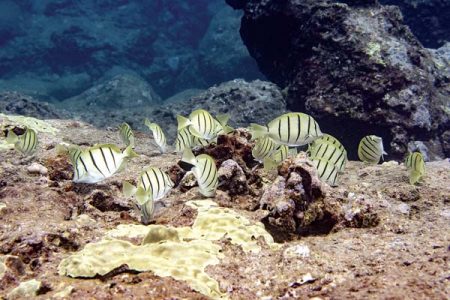
Herbivorous fish that live among reefs, including uhu (parrotfish), kala (unicornfish), manini (convict tang), kole (goldring surgeonfish) and others, primarily eat plants, seaweed and algae, which helps prevent algal populations from overgrowing and overtaking marine organisms such as corals, according to the DLNR.
Limiting the number and/or size of fish caught at one time can ensure that there is "enough fish for us to eat and to keep coral reefs healthy for this generation and the next," Kekoa said.
Kala and uhu populations are considered unsustainable, meaning there are not enough fish to keep the reefs healthy or to support fishing practices for future generations, Kekoa said.
The proposed statewide initiative would prohibit the commercial and noncommercial take of kala that are smaller than 15 inches in length and maturity -- an increase of one inch -- and limit two fishes per person.
Kala are considered a good eating fish and a desired target for spearfishers. The take of undersized kala, especially while night diving, is a common violation of the current regulations, according to the DLNR.
For large-bodied uhu, the proposed rule would prohibit catching ones that are smaller than 14 inches in length, an increase of two inches per the current statewide regulation, though Maui island currently has this regulation. The bag limit is two and fishers cannot take blue uhu.
For small-bodied uhu, the proposed minimum is 10 inches with a bag limit of two.
Uhu as a group are the most commonly caught herbivore by commercial fishers with 537,076 pounds landed between 2011 and 2020, according to DLNR.
The department also is proposing to increase the current minimum length of kole from 5 inches to 6 inches. There is no bag limit proposal.
Similarly, the proposal for manini would increase the minimum from 5 inches to 6 inches. There is no bag limit proposal.
Ryan Okano, DAR program manager of ecosystem protection, said that there's not enough data to propose bag limitations for kole and manini. Kekoa added that fishers in previous meetings did not support bag limits on these two fish species.
Violations may incur criminal and civil penalties. For example, a size limit violation can be anywhere from a $100 to $1,000 fine issued by DLNR's Division of Conservation and Resources Enforcement.
"Protecting the herbivores is trying to help out the habitat, help out the coral," said Okano. "This act of preserving herbivores kind of buys us time. It helps override some of these impacts too, like everybody is worried about the sediment hurting the reef -- a healthy herbivore population makes the reef more resilient and it helps the reef handle this kind of pressure, such as bad water quality."
Maui's Kaniloa Kamaunu, one of about 60 people statewide who tuned in to the virtual presentation, said Monday that there needs to be more education in general on how to "malama aina" and understanding how to take and give back as to not deplete fish populations.
Frustrated by the proposals, Kamaunu said that these regulations should be separated between Native Hawaiian fishers, resident fishers, recreational fishers and commercial fishers.
"We as natives are lumped in with everybody else, which is unfair to us because we do have customary traditional practices that have been set for eons and we try to follow them and then there are other people that come in with other customs that don't follow them," Kamaunu said. "We bring it home so that we can feed ourselves and take care of ourselves."
Lanai resident Kolomona Kaho'ohalahala said the underlying challenge of resolving environmental degradation is that the system is "flawed." Current authoritative entities operate in separate divisions, he said.
"DAR is doing the best that it can within its own authority and the fact that water quality as (Okano) mentions is the jurisdiction of another division, the Department of Health -- that is a real simple example of a real inherent flaw that I am describing," Kaho'ohalahala said. "We live in an ecosystems place. ... There are simple ways that our kupuna have already been established in this place for management."
He suggested a system that manages land and water resources through "seasons of replenishment and seasons of plenty."
"Manage in that way rather than trying to get down to the nitty gritty because that is nearly impossible for anyone to be accurate at any moment in time," he said. "It's impractical no matter how good we try to make the regulations."
DAR's initiative is part of a broader herbivore management strategy and is described in the DAR Sustainable Herbivore Management Plan, released recently after the department held 16 scoping sessions -- 10 last November and six in March of this year -- where they received feedback from local fishers.
Key actions in the plan include implementing both place-based and statewide regulations to promote sustainable fishing practices, enhance monitoring efforts to track changes and evaluate effectiveness of management measures and collaboration with partners to better address land-based impacts.
Implementing new laws and regulations is a lengthy process and this current initiative is still in the early stages, Kekoa said.
After summarizing the proposed set of rules, DAR will take matters to the state Board of Land and Natural Resources for approval. A public hearing will then take place.
Public comment can be submitted online through dlnr.hawaii.gov/marine30x30; by mail to 1151 Punchbowl St., Room 330, Honolulu, HI 96813; or by email to Marine30x30@hawaii.gov.
The management plan can be view at dlnr.hawaii.gov/marine30x30/files/2021/11/Sustainable-Herbivore-Management-Plan_Final-2021-2.pdf.
* Dakota Grossman can be reached at dgrossman@mauinews.com.