
80% of beach parks have ‘low resiliency’ to sea level rise
Solutions could include restoring dunes, relocating parks, acquiring more land, study says
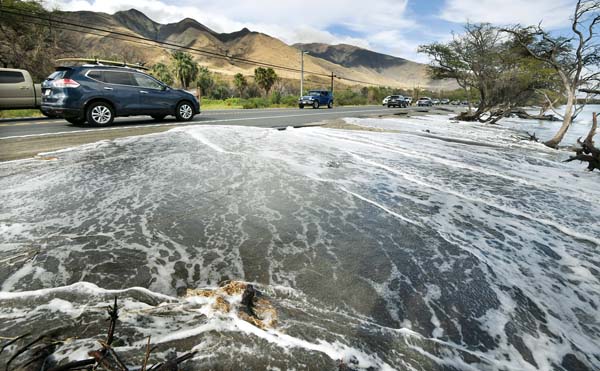
A wave laps the side of Honoapiilani Highway in Olowalu during high tide on July 14. A recent study on the vulnerability of Maui County beach parks showed that more than 80 percent of parks surveyed have a low resiliency to sea level rise impacts. The Maui News / MATTHEW THAYER photo
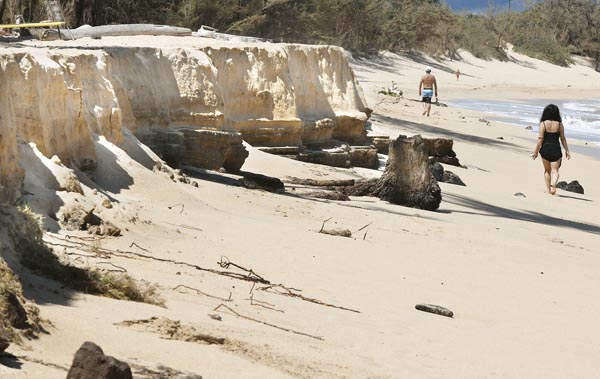
Eroded Baldwin Beach Park features sand cliffs fronting the lifeguard tower Sept. 4, 2020. The Maui News / MATTHEW THAYER photo
A wave laps the side of Honoapiilani Highway in Olowalu during high tide on July 14. A recent study on the vulnerability of Maui County beach parks showed that more than 80 percent of parks surveyed have a low resiliency to sea level rise impacts. The Maui News / MATTHEW THAYER photo
Eroded Baldwin Beach Park features sand cliffs fronting the lifeguard tower Sept. 4, 2020. The Maui News / MATTHEW THAYER photo
Trending
A recent study on the vulnerability of Maui County beach parks showed that more than 80 percent of parks surveyed have a low resiliency to sea level rise impacts.
Mitigative action by the Department of Parks and Recreation needs to start now, even though some coastal threats, such as chronic flooding and erosion, may not occur until 30 years or more in the future, the Maui County Beach Parks Vulnerability and Adaptation Study said.
The Maui County Department of Parks and Recreation launched a project in 2020 to assess the vulnerability of its beach parks caused by sea-level rise and other coastal threats, as well as potential adaptive strategies for each park.
The goal of the study was to assess the vulnerability of parks to coastal hazards and sea level rise; determine the potential for each beach park to adapt to future conditions; identify adaptation strategies for each beach park; develop a prioritization framework for investments in park infrastructure; as well as recommend policies, strategies and actions to address the short- and long-term impacts of climate change.
Sixty-five of the 240 beach parks in the county, as well as the Waiehu Golf Course, were included in the study, and all are expected to experience long-term shoreline change, according to the study.
"The mapping tool is very informative for our residents as well as Department of Parks and Recreation staff," said Maui County Mayor Michael Victorino in a news release Friday. "With climate change, we can't begin too soon to plan for sea-level rise near Maui County's nearshore assets."
The study was funded by the County Council and was conducted with planning and technical assistance by Tetra Tech Inc.
Some coastal threats already evident at beaches include chronic flooding, event-based flooding and erosion, worsening due to rising sea levels and other coastal hazards exacerbated by land use and other human activities.
Among the 240 county facilities, which include restrooms and parking lots, 78 are expected to be exposed to sea level rise within the next 30 years or earlier if "high tide and wave events and storm surge impact the shoreline as has occurred at Baldwin Park," according to the report.
Among the 78 parks, 36 in South Maui, 20 will be impacted in East Maui, 15 in West Maui and seven in Central Maui will be impacted.
West Maui has the most parks with low adaptation potential (eight), meaning a park is highly vulnerable to rising sea levels. These narrow parks have "little to no room" to expand toward the land due to the highway and other development.
South Maui has many parks (16) labeled as medium adaptation.
Access to numerous parks on state and county roads will also be impaired by sea level rise. The study predicts 32 miles will be inundated by sea level rise, impairing access to 40 percent of county parks.
If no action is taken, flooding and land loss due to sea level rise are likely to occur within the next 30 years for 46 parks, or 72 percent, of the 65 parks in the study.
Proposed solutions
The study identified vital recommendations moving forward, such as policymaking, adaptation planning and implementation, education and outreach, and near-term investment priorities.
For example, the longevity of 16 of the 65 parks along the West and South Maui coastlines, such as Puamana Park, Ukumehame Beach Park and Memorial Park, as well as one on Molokai, will depend on adaptation planning -- which includes some solutions like restoring dunes or relocating facilities -- for highways and roads.
Facilities exposed to sea level rise will need to be removed and relocated as appropriate.
Dune and wetlands restoration and preservation is recommended for 12 parks, especially along the north, central and eastern sides of the island, according to the report. Some of these parks include Baldwin Beach Park, Kanaha Beach Park and Kamaole III Beach Park, and two on Molokai that were not named in the study.
"This strategy focuses on nature-based adaptation for parks with the potential to support dune and wetland restoration and preservation," according to the report. "Dune and wetland restoration and preservation will provide natural protection to park infrastructure from coastal hazards such as erosion, high waves and storm surge. Existing and emerging wetlands mitigate flood hazards."
Both sand dunes and wetlands provide habitat for native plants and wildlife too.
Some parks will require retreat and land acquisition to maintain their recreational uses, including Hookipa Beach Park, D.T Fleming Beach Park and Hoaloha Beach Park.
In some cases, a retreat will not be feasible and adjacent land will need to be acquired, the report said.
"This strategy focuses on maintaining park uses by removal and relocation of structures and acquiring of additional land as needed," according to the report.
Three parks - Kalama Park, Kamehameha Brick Palace and Lahaina Courthouse Park - have existing shoreline revetments, which will need to be fortified and possibly raised to preserve the park.
In some cases, though, alternative strategies may be considered, such as returning the park shoreline to a natural environment.
The report said that for eight parks, mainly along the south coast of Maui, maintaining shoreline access as sea level rises may be the only option at this time. The parks assigned this adaptation strategy include Ulua/Mokapu Beach Park, Wailea Beach Park and Pohaku Park.
"This strategy focuses on retaining shoreline access through existing park land," the report said. "Coastal erosion with sea level rise will result in the loss of many beaches enjoyed by residents and visitors. Even with beach loss, access to the shoreline needs to be retained. Parks assigned this strategy are in highly developed areas."
Twenty parks, such as Keanae Park, Keopuolani Regional Park and Halawa Park, have a relatively high adaptation potential and can be maintained as-is over time "as long as no new structures are put in hazard areas."
The report said that this strategy focuses on monitoring and maintaining facilities until park conditions change.
Residents can view the online study of sea-level rise and other coastal threats of 65 of 240 beach parks and adaptation strategies for each park by visiting https://www.mauicounty.gov/BPVAStudy.
The website provides a project overview, resources, and an adaptation and mapping tool.
The project is ongoing and the website will be updated as future phases are completed, the county said.
For more information, call planner David Yamashita at (808) 270-6508 or email david.yamashita@co.maui.hi.us.
* Dakota Grossman can be reached at dgrossman@mauinews.com.