
Mahi Pono starts summer watermelon harvest
Company harvested onions in May, aims for 2 million pounds of produce this year
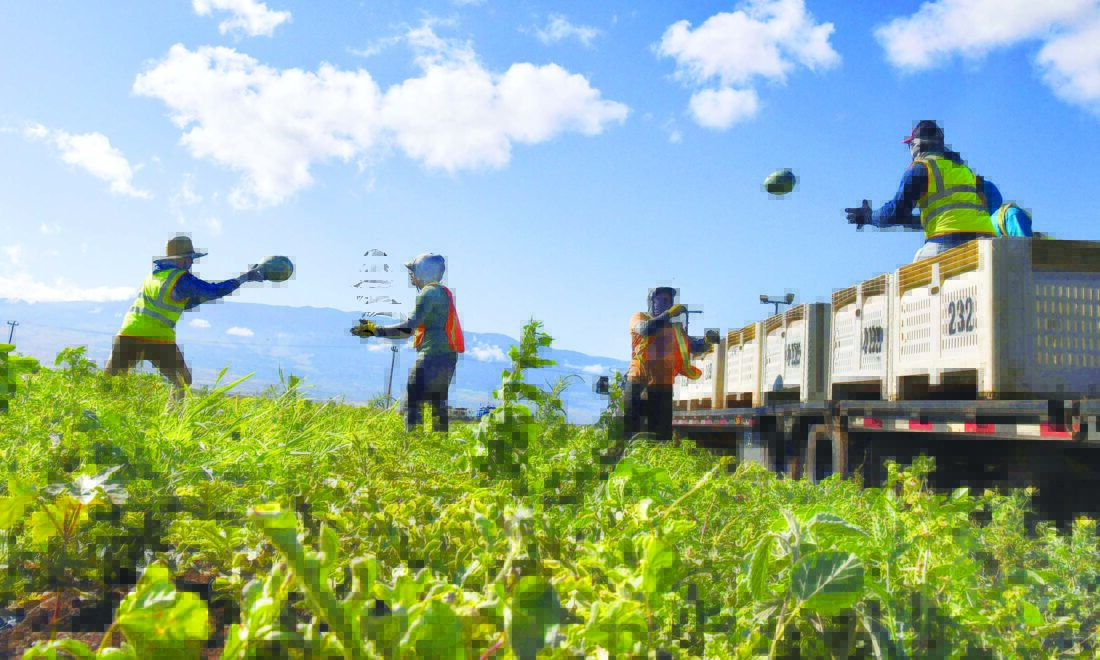
Harvesting crew members shuttle melons to waiting bins Thursday. In its first full week of harvesting, the watermelon crop is expected to run through mid-September. Company officials said this year’s poundage goal for the 84-acre field is 1.5 million pounds. Row Crops Operations Manager Kyle Studer said yearly production is scheduled to continue to increase for watermelons and onions, and that both crops were doing well. He said the Cracker Jack variety watermelons being harvested have “firm flesh and high sugar content.” The melons are to be available in some Maui stores, including Costco, under the Maui Harvest brand. — The Maui News / MATTHEW THAYER photo

— The Maui News / MATTHEW THAYER photo

— The Maui News / MATTHEW THAYER photo
Harvesting crew members shuttle melons to waiting bins Thursday. In its first full week of harvesting, the watermelon crop is expected to run through mid-September. Company officials said this year’s poundage goal for the 84-acre field is 1.5 million pounds. Row Crops Operations Manager Kyle Studer said yearly production is scheduled to continue to increase for watermelons and onions, and that both crops were doing well. He said the Cracker Jack variety watermelons being harvested have “firm flesh and high sugar content.” The melons are to be available in some Maui stores, including Costco, under the Maui Harvest brand. — The Maui News / MATTHEW THAYER photo
— The Maui News / MATTHEW THAYER photo
— The Maui News / MATTHEW THAYER photo
Trending
Thousands of watermelons are ripe and ready to eat just in time for summer as Mahi Pono completes a massive seasonal harvest.
The farming company, which owns and operates about 41,000 acres of agricultural land in Central Maui, picked 6,210 watermelons from the fields of Puunene last week and will be primarily selling them locally on island, with some being shipped to Oahu and Hawaii island.
"If Maui retailers are interested they can contact Kula Produce and ask for Maui Harvest/Mahi Pono watermelon," said Community Relations Director Tiare Lawrence. "Kula Produce is committed to distributing the majority of our supply."
Kula Produce Maui is located at 217 Hoohana St. in Kahului.
Mahi Pono's row crop operation aims to cultivate an estimated 2 million pounds of fresh local produce this year, according to the company website. The produce, such as watermelon, will be distributed to restaurants, grocery stores, food hubs and local institutions statewide.
In the island's central valley, spanning from pockets of Maalaea and North Kihei to the north shore, orchard and row crops currently planted and planned for planting include lime, lemon, orange, tangerine, coffee, avocado, macadamia nut, ulu, onion, kale, lettuce, watermelon, bananas, coconut and lilikoi.
"Our three most currently available crops are limes, watermelon and onions due to local demand and seasonality," Lawrence said.
In partnership with Armstrong Produce, Kula Produce and Sun Fresh Hawaii, Mahi Pono conducted its seasonal onion harvest in May to distribute nearly 2,000 pounds of onions to local retailers through mid-August, including Tamura's, Pukalani Superette, Target and ABC Stores, according to the company's website.
As of December, Mahi Pono had also planted more than 1.64 million trees on about 8,625 acres of land. The company also prepared over 9,000 acres of grass pasture land to support Maui Cattle Company's grass-fed beef operations.
In the future, Lawrence said that Maui Pono is considering an opportunity to increase avocado plantings.
"Maui has ideal growing conditions for avocado production and in need of local supply," she said. "We will be planting a trial field of local varieties in our upper fields around the 500-foot elevation next year."
But in the meantime, the company is preparing for dry and windy conditions this summer, which has already begun to plague areas in South, Central and West Maui.
"We expect to experience dry windy conditions," Lawrence said. "We are working to install more windbreak trees in the fields and have established protocols to avoid dust during heavy winds. The buildout of our orchards will help improve soil erosion over time."
As Mahi Pono continues farming operations, disputes over water use for crops and other uses continue in the courts.
In mid-June, an Environmental Court judge lowered the amount of water that Alexander & Baldwin and East Maui Irrigation could divert from East Maui streams. EMI is jointly owned by A&B and Mahi Pono.
Mahi Pono said at the time that it was reviewing the judge's decision and remained "committed to increasing food security for our state and reducing our island's reliance on imported crops."
The decision reduced the total permitted water allocation from about 40.5 million gallons per day to 31.5 mgd, though it kept Mahi Pono's allocation the same at 27.91 mgd. According to court documents, Mahi Pono has been using about 18 mgd.
* Staff Writer Dakota Grossman can be reached at dgrossman@mauinews.com.