UH Mānoa tackles wastewater emissions with $2M grant
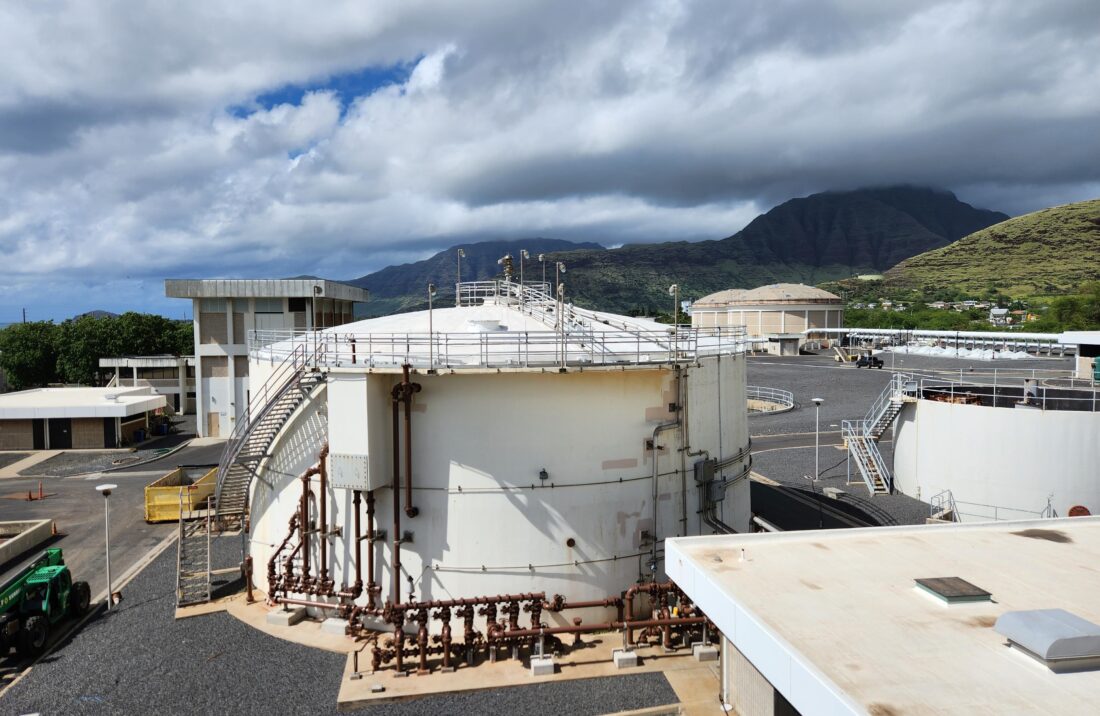
Testing will be done at the Waiʻanae wastewater treatment facility.
A new University of Hawaiʻi at Mānoa project is working to develop innovative technology to reduce greenhouse gas emissions from wastewater treatment facilities.
The research team includes Zhiyue Wang, assistant professor in the Department of Civil, Environmental and Construction Engineering and the Water Resources Research Center, and Tao Yan, professor in the Department of Civil, Environmental and Construction Engineering and director of the Water Resources Research Center.
Together, the team aims to investigate a new process that could significantly decrease the environmental impact of traditional nitrogen removal methods in wastewater treatment.
Removing nitrogen from wastewater is crucial because excess nitrogen can cause harmful algae blooms in lakes and oceans, while conventional treatment processes release a significant amount of greenhouse gasses that contribute to climate change.
The effort is supported by a $1.99 million grant from the U.S. Department of Energy, awarded to Kennedy Jenks, a water and environmental engineering and environmental sciences firm.
The UH team will work with Jenks and the city and county of Honolulu to run pilot-scale testing at the Waiʻanae wastewater treatment facility starting in 2025.
“This research is particularly crucial for Hawaiʻi, where our unique island ecosystem demands innovative solutions to protect our environment and manage our resources sustainably,” Wang said in a statement. “By developing technology that can reduce greenhouse gas emissions from wastewater treatment while potentially increasing energy recovery, we’re not only addressing global climate concerns but also working towards greater energy independence for our island communities.”
At the heart of this project is the development of the coupled aerobic-anoxic nitrous decomposition operation process, an approach that focuses on converting ammonia — a common component in wastewater — into nitrous oxide.
Nitrous oxide can then be burned alongside biogas, improving overall energy efficiency at treatment facilities. Recovery of nitrous oxide — which is 300 times more potent than carbon dioxide — can greatly reduce its release into the atmosphere as well.
Researchers aim to achieve an 80% nitrogen removal rate and a 60% nitrous oxide conversion rate through this method.
If successful, the new technology could reduce greenhouse gas emissions from nitrogen removal processes by 50% or more, according to the team. The project also aligns with the U.S. Department of Energy’s goals for decarbonization in the water treatment sector.
The effort could also address challenges associated with co-digestion, a common practice in wastewater treatment where additional organic waste is added to improve biogas production.
While beneficial, co-digestion can lead to increased ammonia levels, which contribute to greenhouse gas emissions. The CANDO process offers a potential solution by converting this excess ammonia into a usable energy source.
Researchers believe this technology could be integrated into existing wastewater treatment facilities, providing both environmental and economic benefits. The project team estimates that implementing CANDO could increase energy generation from co-digestion by 5% through nitrous oxide recovery.
Local News

County announces agreement with Maui Land & Pineapple to acquire West Maui water system, other assets
Affordable Housing Grants for Nonprofits
Hawaii nonprofits supporting families and residents in need of affordable housing are being encouraged to submit ...
Community Invited to Join the 2026 Maui Ride of Silence
Annual memorial ride honors lives lost on Maui’s roads and raises awareness for safer streets for all. The ...
Presentation at Kihei-Wailea Rotary, Wednesday, May 20
The Arts Belong Here: Our Youth and Maui Nui Performing Arts Future. Mr. Barry Kawakami will share how a new ...
African Penguin Chick Hatches at Hyatt Regency Maui
Hyatt Regency Maui Resort and Spa, announces the hatching of its first African Penguin (Spheniscus demersus) chick ...