Humpback whale counts on Maui show stable numbers
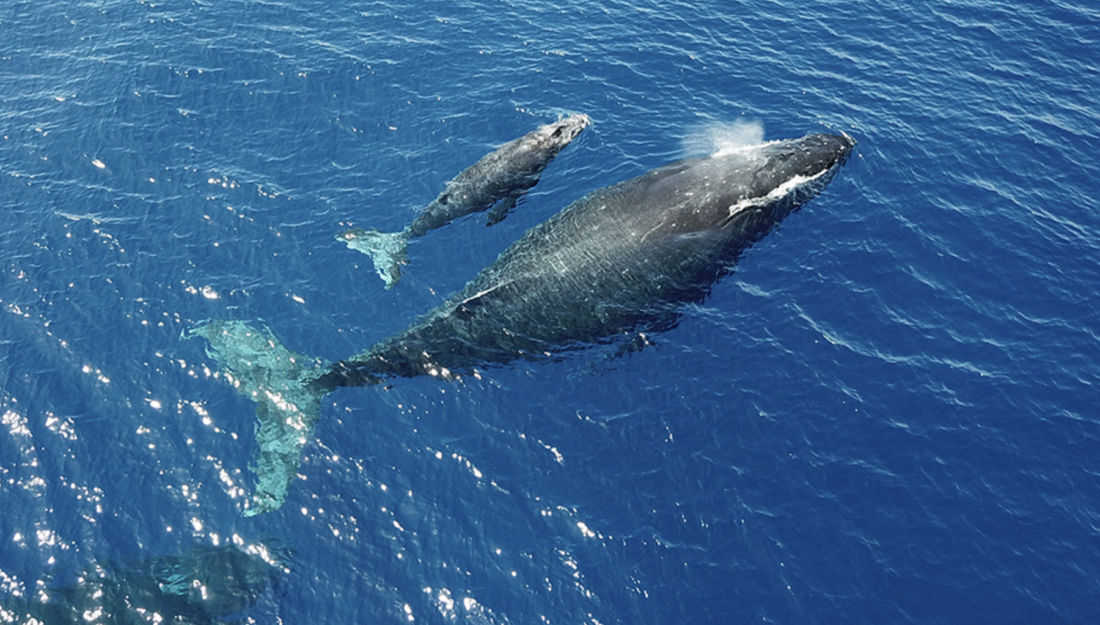
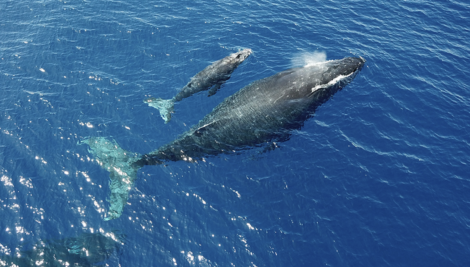
A mother humpback whale and her calf swim in waters off Maui. The whales come to Maui every winter as part of their migration cycle. Photo courtesy National Atmospheric and Oceanic Administration
The number of whales counted in waters off Maui Nui appears to be about the same as last year.
Pacific Whale Foundation chief scientist Jens Currie said the numbers counted from 8:30 a.m. to noon Jan. 31 at 11 sites totaled 694 compared to 700 last year.
“It’s very good to see the numbers are about the same,” Currie said. “It’s good to see there aren’t any clear decreases.”
Started in 1995, the Great Whale Count has served as a snapshot of the humpback whales that migrate from the North Pacific to Hawaii.
The foundation shares its numbers with the National Atmospheric and Oceanic Administration, which began conducting a similar count in 1996 at sites on Oahu, Kauai and the Big Island. Hundreds of volunteers with binoculars are enlisted in the statewide count.
“It’s an opportunity to engage the public,” Currie said.
About 90 volunteers and 22 supervisors participated in January’s whale count, and there are openings for more volunteers when the whale counts resume in February and March.
Population numbers up since 1960s
The number of humpback whales has climbed significantly since the 1960s when estimates indicated they were near extinction in the North Pacific.
More than 30,000 humpback whales were hunted and killed before 1966, leaving an estimated population of 1,500 before a moratorium was imposed by the International Whaling Commission.
The United States listed humpbacks as endangered under the Endangered Species Conservation Act in 1970 and the Endangered Species Act in 1973.
The humpback whale population in the North Pacific suffered a 20% decline from 2013 to 2016 because of marine heat waves reducing food sources.
The population has been estimated at between 26,000 and 30,000, according to NOAA.
Tracking whales
Humpback whales are about the size of a bus with flukes as wide as 18 feet. Markings on the flukes are distinct enough they can be used to identify individual whales and help track the whales during migrations to Hawaii.
Currie said the foundation has one of the largest collections of known whale flukes.
A distinct group of humpbacks in the North Pacific filter feed during the summers in Alaska and adjacent waters, mainly on krill and small schooling fish. The whales spend their winter months mating and calving in warm tropical waters off the Hawaiian Islands.
The whales can complete their 3,000 mile journey from Alaska to Hawaii in as few as 28 days, according to NOAA.
On average, a mother can produce a calf in two to three years, and a calf, born after an 11 month gestation period, can measure 13 to 16 feet in length.
During whale watches, a mother and its calf are sometimes seen, as the calves learn to swim and dive in preparation for their journey back to Alaska.
Protecting humpbacks
During whale season in Hawaii, which runs from November through May, boat captains are advised to have a dedicated lookout and maintain speeds of 15 knots or under in shallow waters of 100 fathoms or less, according to the state Department of Land and Natural Resources.
The department said that when a vessel comes within 400 yards of a whale, the operator should reduce speeds to 6 knots.
Vessels are not allowed to approach a humpback whale any closer than 100 yards away. In addition, the state has a ban on thrill crafts operating from Dec. 15 to May 15 along West and South Maui shores.
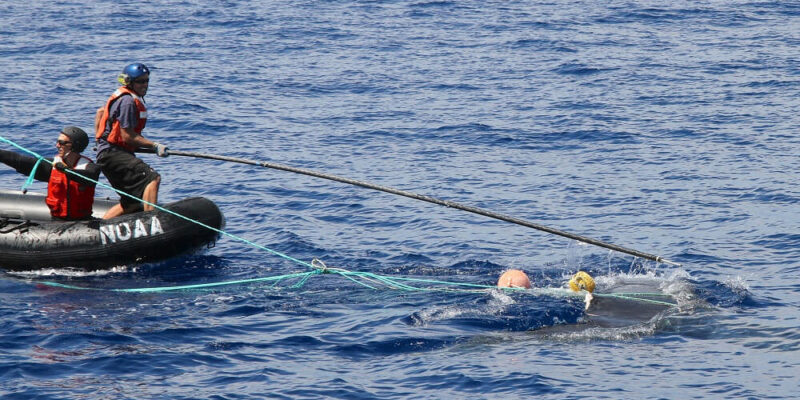
A humpback whale is rescued from entangled fishing gear using a special knife on a pole. The method was developed at the Hawaiian Islands Humpback Whale National Marine Sanctuary by rescuers David Matilla and Ed Lyman and taught to some 1,800 trainees in 45 countries. Photo courtesy National Atmospheric and Oceanic Administration
Maui sanctuary leads in whale rescues
The Hawaiian Islands Humpback Whale National Marine Sanctuary, established by Congress in 1992 and based on Maui, is jointly managed by the state, NOAA and the National Marine Sanctuaries, and covers 1,370 square miles around the Hawaiian Islands.
The sanctuary protects 4,000 to 5,000 whales, or about two-thirds of the North Pacific humpback whale population.
The sanctuary has been on the cutting edge of developing methods and instruments to rescue whales entangled by fishing nets and lines.
The methods have been used to rescue whales at other national marine sanctuaries including the Stellwagen Bank National Marine Sanctuary in Massachusetts and the Monterey Bay National Marine Sanctuary in California, and by scores of foreign countries.
The rescues involve riding on an inflatable raft and using a 15- to 20-foot pole to cut the ropes away from the whale. Maui whale rescue team members David Matilda said he and Ed Lyman were methodical in developing safety procedures.
“It definitely is a risky operation,” said Matilla, now a retired research coordinator. “We developed different tools and protocols. You need to be careful.”
Lyman used an underwater camera to see the location of rope entanglements beneath the ocean surface, and the technique has also been aided by the use of drones to get an aerial view.
Matilla, who once worked at the Maui whale sanctuary office, said while working for NOAA on the East Coast, he was loaned to the International Whaling Commission to help to develop international response capabilities in whale rescues.
During the years, the trainees totaled about 1,800 people from 45 different countries, including Japan, Russia, and Tonga.
Matilla credited Lyman in getting people to work together in training and as a team.
He described his feeling about the work to be “bittersweet,” because the nets and ropes continue to be a problem.
“We had hoped that by now we wouldn’t have gotten out of doing it,” Matilla said.
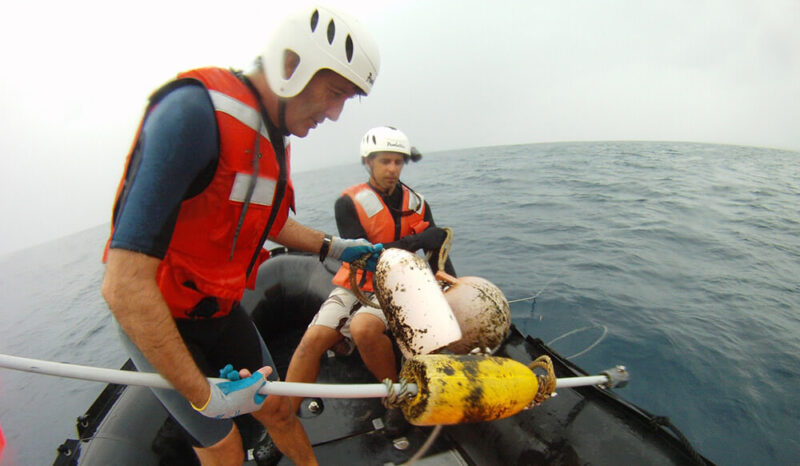
Ed Lyman examines debris cut away from a whale after a whale rescue. Photo courtesy National Atmospheric and Oceanic Administration
Local News
Records, relays highlight MIL swimming championships

Aloha Volleyball 14U boys team wins gold at TransPacific Volleyball Tournament
Coast Guard praises Trilogy tours for rescue help
Humpback whale counts on Maui show stable numbers

Coming Saturday, HeartFest promotes healthy lifestyles with fun activities, free screenings