
Maui residents, leaders strongly oppose adding telescopes on Haleakala

This map shows the Amos Star project, a proposal to build up to seven new telescopes in a state conservation district at the summit of Haleakala. Courtesy photo
Addressing more than 150 Maui residents, U.S. Air Force Lt. Col. Douglas Thornton spoke Tuesday about a plan to build as many as seven new telescopes in a state conservation district at the top of Haleakala.
Dubbed the Amos Star project, Thornton said the new telescopes would allow the Air Force to better track objects in space and prevent debris from disrupting satellites that provide essential services such as guiding cars and airplanes, enabling weather forecasts and allowing for the operation of global financial networks.
“This is a profound responsibility that directly benefits our community and the world,” Thornton said during a meeting at the Kihei Community Center seeking public comments.
“Space is no longer a vast frontier,” Thornton continued. “It is a congested and contested domain. We depend on satellites every single day for our services.”
Ten telescopes — six for academic purposes and four for space surveillance — already sit at the top of Haleakala, which is far removed from light pollution and one of the best places in the world for stargazing.
However, every resident who spoke Tuesday rejected the idea, as none of the dozens of people who delivered public testimony on the project’s draft environmental impact statement spoke in favor of the Air Force’s plan.
About 10 years ago, protesters were arrested for blocking the road to Haleakala in an attempt to stop the development of the Daniel K. Inouye Solar Telescope. The Maui County Council and Mayor Richard Bissen have both come out opposed to the expansion, which is scheduled to take two years.
Many of the people who attended Tuesday’s meeting were of Native Hawaiian descent and highly critical of the U.S. military. They spoke of the military’s failure to be good stewards of the land, including the nearby island of Kahoolawe, and cited the fuel spill at Red Hill on Oahu and a 720-gallon diesel spill at the Maui Space Surveillance Complex on Haleakala in 2023.
“How can we allow you to continue to desecrate our mama when you have not been good stewards,” Lisa Galloway said.
Galloway said preventive maintenance measures were not performed before the diesel spill even though it had been brought to the attention of senior Air Force management.
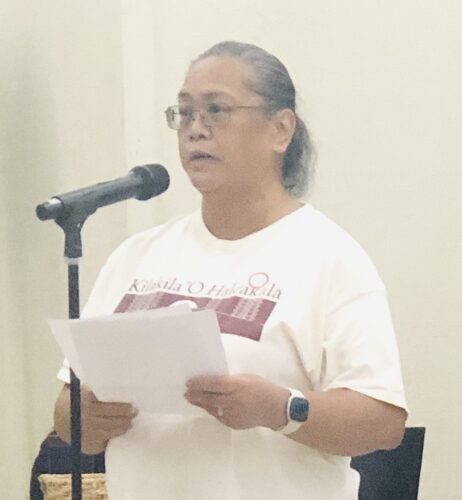
Maui resident Lisa Galloway is opposed to the U.S. Air Force’s proposal to add up to seven telescopes on Haleakala. Gary Kubota/The Maui News
Many of the residents who spoke Tuesday focused on how the summit of Haleakala is sacred ground for Native Hawaiians, the realm of the Hawaiian gods and a place where they exercise traditional and religious practices. Hawaiian stories describe how the demi-god Maui extended the day by wrangling the sun from the summit of Haleakala.
Other residents spoke about the lack of a plan to protect endangered plants and birds including the silversword and Hawaiian petrel that nests in underground burrows in volcanic cinders.
Other people said the Air Force does not make Maui safer, but instead makes the island a target because of the ability to track objects in space and kill enemies in other countries.
“Your presence threatens our security,” Maui Council member Keani Rawlins-Fernandez said.
“You make our island a target.”
Some Native Hawaiians also raised questions about the legitimacy of the U.S. military in Hawaii based on the illegal 1893 overthrow of the Hawaiian monarchy.
“You have no rightful authority or legal jurisdiction over any land in Hawaii including Haleakala,” Galloway said. “You are here on stolen land.”
Written comments about the draft environmental impact statement can be submitted through March 16 at www.amosstareis.com/home.
Local News

Broadway stars join Maui Pops to celebrate music of Rodgers and Hammerstein

Whale Tales 2026 opens today at the Ritz-Carlton Maui, Kapalua

Kula looms large in Chinese history as Maui celebrates Year of the Horse

Maui residents, leaders strongly oppose adding telescopes on Haleakala

Photo of the Day: Cheery Dendrobium
Maui Health opens applications for paid summer interns
Maui Health is taking applications for its 2026 Paid Summer Internship Program, offering college students an ...