Volunteers work to honor Maui’s early Korean immigrants
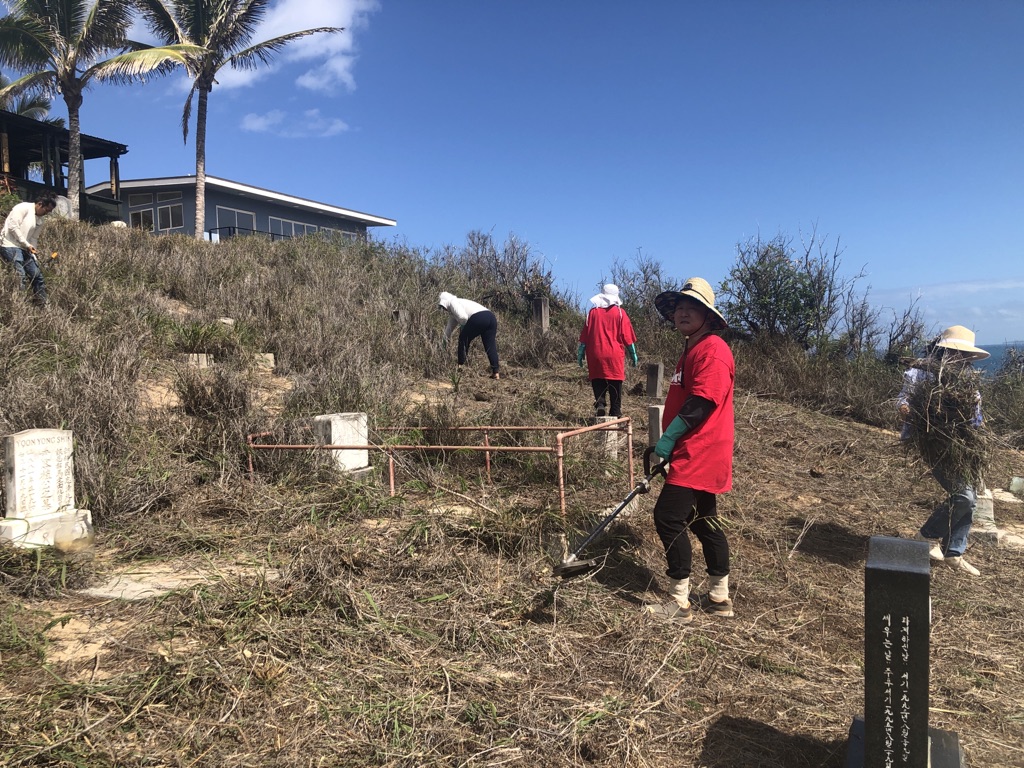
Volunteers worked to clear brush around gravestones for people who were among the first wave of Korean immigrants to arrive on Maui in the early 1900s. Gary Kubota/The Maui News
Across a slope below Waiehu Heights overlooking Kahului Harbor, several volunteers with weed wackers and tree trimmers cut through brush that had overgrown grave stones of the first wave of Korean immigrant workers to come to Hawaii in 1903.
“We want to take care of our ancestors and honor the immigrants who have paved the way for future generations to get a foothold in the community,” said Tommy Lee, the head of the Maui Korean Community Association. “We’re giving back to take care of their graves.”
To honor the workers, the association has combined its efforts with members of the Maui Full Gospel Korean Church in Kahului and the Rev. Jeongwoan Seo and the Maui Onnuri Church in Kahului and pastor Sung Yun Kim.
None of the volunteers are direct descendants of those buried at the Korean cemetery, but several volunteers said they have made a commitment to the project to honor the pioneers, their culture and their place in Hawaii history.
The first group with 102 immigrants included 56 men, 21 women and 25 children, recruited by the Hawaii Sugar Planters’ Association.
They arrived on the RMS Gaelic on Jan. 13, 1903.
By 1905, a total of 7,000 Korean immigrants had come to Hawaii. About half eventually moved to the U.S. continent, according to the Center for Korean Studies at the University of Hawaii.
The Korean immigrants faced famine from a drought in their country in the early 1900s, prompting many to migrate elsewhere. At the time, Hawaii sugar and pineapple farms were looking for a different group of workers to avoid labor difficulties associated with Japanese immigrants.
A second wave of Korean immigrants occurred in the 1950s prompted by the Korean War.
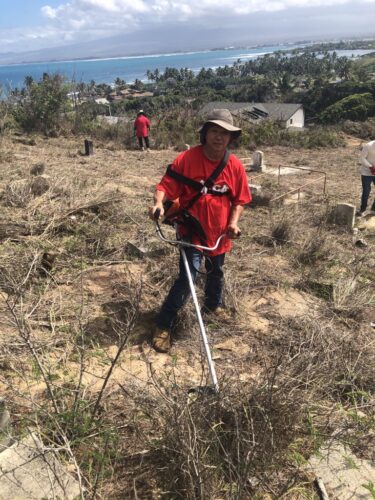
Maui Korean Community Association head Tommy Lee helps clear brush at a cemetery on the slopes of Waiehu Heights where some of the people in the first wave of Korean immigrants to Hawaii are buried. Gary Kubota/The Maui News
Lee’s son, Jae Hyok Lee, is a graduate of Baldwin High School. The son said the work is part of an effort to revive the Maui Korean Community Association.
“I want to see it continue,” he said. “I’m doing whatever I can to help out.”
The association has worked to re-establish a path from the Chinese-Hawaiian cemetery on Kahekili Highway to the Korean cemetery and cleared brush around scores of gravestones.
Waiehu Heights homeowner Lee Krusa, who lives on a ridge near the Korean Cemetery, was among the volunteers.
Krusa said he and other Waiehu Heights owners have been worried about the potential for wildfires and clearing the brush from gravesites helps ease those concerns as well.
“This is wonderful,” Krusa said. “It’s so appreciated.”
The work isn’t finished, and the volunteers are coming back. They’re inviting others to join them for a second cleanup on Feb. 14.
For more information, call Lee at 808-357-2900 or email DHL68@yahoo.com.
Local News
Records, relays highlight MIL swimming championships
Aloha Volleyball 14U boys team wins gold at TransPacific Volleyball Tournament
Coast Guard praises Trilogy tours for rescue help
Humpback whale counts on Maui show stable numbers
Coming Saturday, HeartFest promotes healthy lifestyles with fun activities, free screenings