
CAPOBIANCO SENTENCED: Judge calls murder ‘senseless’ but leaves open parole possibility
Victim’s family, friends berate ex-boyfriend as he gets life in prison
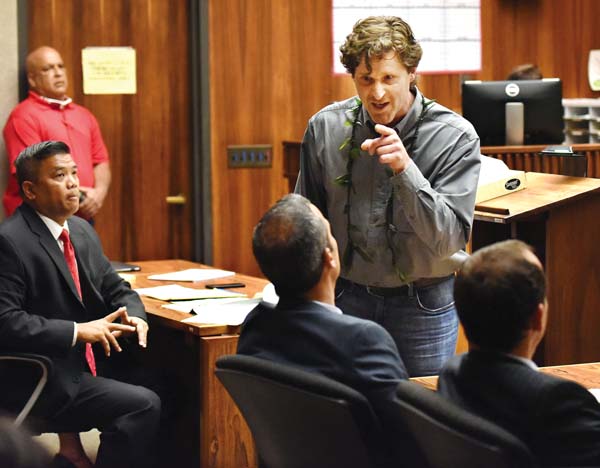
Robert Scott, father of Carly “Charli” Scott, points toward defense attorney Jon Apo at the conclusion of his statement in 2nd Circuit Court on Friday during the sentencing of convicted killer Steven Capobianco. Scott expressed anger over some of the questions posed by Apo to the victim’s sisters. He was removed from the courtroom. -- The Maui News / MATTHEW THAYER photo
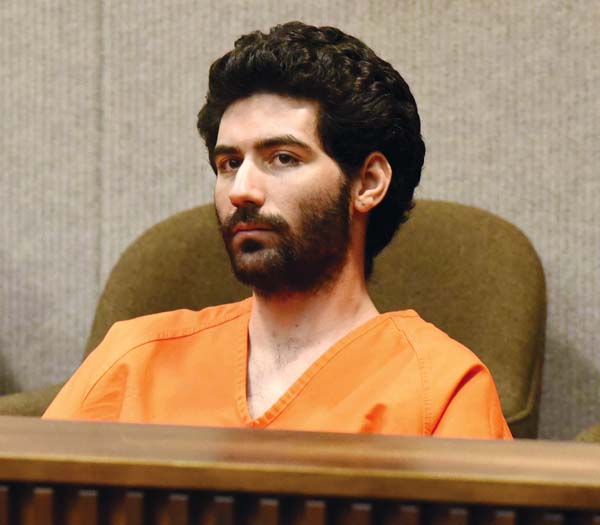
In sentencing Steven Capobianco on Friday, Judge Joseph Cardoza said it was the court’s recommendation that he serve a minimum of 70 years before being eligible for parole on the second-degree murder conviction and all 10 years on the second-degree arson conviction. -- The Maui News / MATTHEW THAYER photo
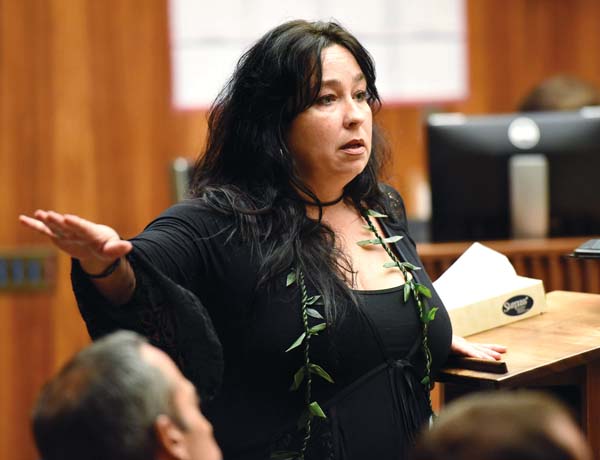
Kimberlyn Scott, mother of murder victim Carly “Charli” Scott, asks Steven Capobianco to reveal the location of her daughter’s remains while addressing the court in his sentencing Friday. -- The Maui News / MATTHEW THAYER photo
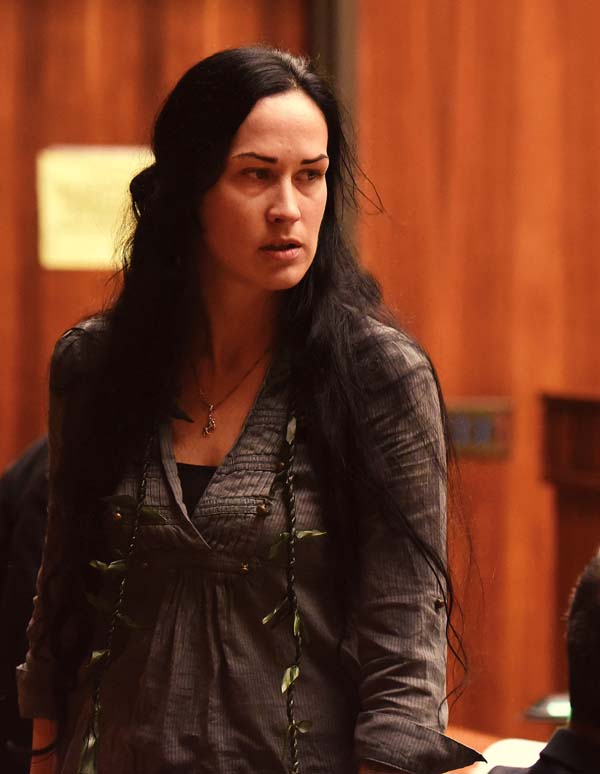
Brooke Scott, a sister of Carly “Charli” Scott, scowls at Steven Capobianco after making her statement in the court Friday. -- The Maui News / MATTHEW THAYER photo
Robert Scott, father of Carly “Charli” Scott, points toward defense attorney Jon Apo at the conclusion of his statement in 2nd Circuit Court on Friday during the sentencing of convicted killer Steven Capobianco. Scott expressed anger over some of the questions posed by Apo to the victim’s sisters. He was removed from the courtroom. -- The Maui News / MATTHEW THAYER photo
In sentencing Steven Capobianco on Friday, Judge Joseph Cardoza said it was the court’s recommendation that he serve a minimum of 70 years before being eligible for parole on the second-degree murder conviction and all 10 years on the second-degree arson conviction. -- The Maui News / MATTHEW THAYER photo
Kimberlyn Scott, mother of murder victim Carly “Charli” Scott, asks Steven Capobianco to reveal the location of her daughter’s remains while addressing the court in his sentencing Friday. -- The Maui News / MATTHEW THAYER photo
Brooke Scott, a sister of Carly “Charli” Scott, scowls at Steven Capobianco after making her statement in the court Friday. -- The Maui News / MATTHEW THAYER photo
Trending
WAILUKU -- For what a judge called the "senseless, cold, calculated" killing of a pregnant woman and the burning of her vehicle, convicted murderer Steven Capobianco was sentenced Friday to life in prison with the possibility of parole plus 10 years.
Second Circuit Judge Joseph Cardoza said it was the court's recommendation that Capobianco, 27, serve a minimum of 70 years before being eligible for parole on the second-degree murder conviction and all 10 years for the second-degree arson conviction.
He said that the Hawaii Paroling Authority would determine Capobianco's minimum terms after meeting with him within the next six months.
"Your actions were senseless," Cardoza told Capobianco. "They were cold, they were calculated . . . and for that, you must serve an extremely severe penalty under the law. And the community, all communities, must be protected from you."
Cardoza said the case stood out "for its length and the interest it has generated, as well as the kind of actions that were proven here."
Much of the trial, including Friday's sentencing, was broadcast through live-streaming over the internet.
On Dec. 28, after a trial that spanned more than seven months, a jury found Capobianco guilty as charged of murdering his pregnant ex-girlfriend Carly "Charli" Scott and setting fire to her vehicle.
Capobianco was the last person known to have seen Scott alive.
He told police that on the night of Feb. 9, 2014, she drove him from Haiku to about 3 miles past Keanae, where he said his truck had stalled the night before. After fixing a loose battery cable on his truck, Capobianco said he was driving back to Haiku, with Scott following, when he lost sight of her headlights in the Twin Falls area.
At the time, the 27-year-old Makawao resident was five months pregnant with a son fathered by Capobianco.
Scott's dog Nala, who had been with her that night, was found at Nahiku Marketplace the morning of Feb. 10, 2014. Her 1997 Toyota 4Runner was found burned near the "Jaws" surf spot in Peahi.
In the late afternoon of Feb. 13, 2014, searchers including Scott's teenage half sister found the tank top and black shirt Scott was last seen wearing, as well as her maggot-infested green blanket at Nuaailua Bay. The remote bay is about 4.5 miles toward Haiku from the location along Hana Highway where Capobianco said his truck had stalled.
After the discovery of Scott's clothing and blanket, police officers searched the area and found more evidence, including pieces of Scott's jawbone, a black bra, five fingernails, clumps of red hair and a body piercing with some flesh attached.
On Friday, more than 50 people -- including Scott's family members and friends and several of the jurors -- were in the courtroom gallery for Capobianco's sentencing hearing, which lasted nearly four hours.
When defense attorney Jon Apo asked if a shackled Capobianco could be moved from the jury box to sit next to his attorneys, several people in the gallery shouted "no," with one saying, "We need to see his eyes."
Cardoza said that the court wasn't asking for comment from the gallery and cautioned that those who didn't behave appropriately would be excluded from the courtroom.
Capobianco remained in the jury box as the sentencing continued, with a dozen of Scott's family members and close friends speaking.
"I truly believe, with all my heart, that he deserves to never see the light of day again," said Adam Gaines. "And that's coming from someone that really used to care for Steven. There's nothing good or decent inside him."
Addressing Capobianco, Gaines said, "You're a purely sociopathic person that hasn't shown one ounce of remorse or regret for this disgusting action you planned and executed."
Along with others, Gaines asked Capobianco to tell Scott's family where she and her unborn son, Joshua, were. "If you have the tiniest sliver of decency left in your cold black heart . . . tell us where they are," Gaines said.
Kimberlyn Scott said that when she asked her daughter why she was with Capobianco, "she would tell me she knew you inside and how hurt you had been and she thought she could help you."
"I pitied you . . . and then I realized, Steven, you did have love. You had her," Scott said. "And you know what you did with that love? You stabbed it 27 times. You cut it into pieces. You destroyed it. You destroyed the only love you will ever have."
Charli Scott's father, Robert Scott, a Seattle resident, said that although he had tried to free himself of anger and vengeance, "turns out I have it."
"Turns out it's an innate human characteristic in me," he said. "It's very strong. If the courts, the justice system doesn't provide this, who will? If this retribution is not satisfied, I will do it myself."
After saying "some things crossed the line" during the trial, Scott pointed a finger in Apo's face. "You should be ashamed of yourself and I spit on you," Scott said.
Cardoza asked sheriff's deputies to remove Scott from the courtroom, saying "that was inappropriate."
First Deputy Prosecuting Attorney Robert Rivera said Capobianco was "the epitome of a monster" who embraced evil.
Capobianco and Charli Scott were opposites, with family and friends describing her as "selfless, warm, loving," Rivera said.
"Charli Scott accomplished so much more than many of us in life, especially more than the defendant in his life," Rivera said. "She was able to mobilize an entire community to look for her, to become acquainted with her through her friends and family."
Rivera argued for an enhanced sentence of life in prison without the possibility of parole for Capobianco.
Apo said that if Capobianco received the enhanced sentence, "it's just one more grounds for appeal."
In a report prepared for his sentencing, Capobianco confirmed that "he intends to exhaust all appellate remedies," Apo said.
Capobianco said he didn't want to speak in court Friday.
The judge could consider the enhanced sentence because the jury that convicted Capobianco also found that Scott's murder "was done in an especially heinous, atrocious or cruel manner, manifesting exceptional depravity."
In deciding not to impose enhanced sentencing, Cardoza said he had to apply the law, which requires that the defendant inflicted "unnecessary torture" causing "extreme physical or mental suffering beyond that which necessarily accompanies the underlying killing."
Cardoza referred to an appellate court ruling that didn't sustain enhanced sentencing in a case where the victim was beaten to death with a hammer in front of witnesses.
"It could not be proven beyond a reasonable doubt that the death subjected the victim to extreme torture, as there was no proof of the specific manner of death and the condition of the decedent after the first blow, which came very quickly and was obviously a blow of serious proportions," Cardoza said, referring to the appellate case.
In Capobianco's case, "there is absolutely no question that the murder of a pregnant woman is outrageous and horrific," Cardoza said.
"It is conscienceless and it is pitiless," he said. "But that's not enough under the law.
"To date, no one has been able to present to this court the specific manner of death such that it can be said that the victim suffered unnecessary torture as defined under the law, not as defined by plain language," Cardoza said. "Because of the manner in which this offense was committed and the manner in which the defendant sought to hide this crime and to escape detection, no one has been able to state the exact manner of death."
Referring to trial testimony that Capobianco didn't share in Scott's excitement about her pregnancy, Cardoza said it was "incomprehensible" that Capobianco would think of killing her to avoid becoming a father "with a woman he did not want to be with."
"I have yet to observe or read or see any murder case where there is any logical reason behind the decision to intentionally or knowingly end the life of an innocent human being," Cardoza said. "One can never find any reason or logic behind a murder because there is none."
He said one "irony is that the defendant failed to comprehend that he was already becoming a forgotten footnote in Carly Scott's life."
With her pregnancy, Scott's attention had turned to the responsibilities of becoming a mother, Cardoza said.
In February 2014, she wasn't pursuing a relationship with Capobianco.
"Carly Scott did not seek out the defendant on the night that he chose to end her life," Cardoza said. "It was the defendant who reached out to Carly Scott to lure her into his deadly plan. He inflicted on her the most serious harm that can be inflicted on another human.
"But for a few missteps along the way, he may well have gotten away with murder."
Among the missteps cited by the judge was the discovery of a pair of blue jeans stained with Scott's blood that was found over a guardrail along Hana Highway a few days after Scott disappeared.
Cardoza said Scott was "deprived of her life, the birth of her son, the years of growing with him and the years of love she would have undoubtedly shared with him."
"That is so tragic and senseless," Cardoza said.
"Why you would have deprived yourself of the gift of your son is almost impossible for anyone to understand and is suggestive of self-centered thinking," the judge told Capobianco. "Someday, somehow you will need to comprehend the tragedy you have created."
With the defense contesting a $3,548 claim for Scott's vehicle, laptop and cellphone, a restitution hearing was set for May 4.
Outside the courthouse Friday, Robert Scott said he watched the live feed of court proceedings after being removed from the courtroom.
He and Kimberlyn Scott said that the sentencing didn't bring them closure.
"I'm trying to approach today as a good milestone, even if we didn't get everything we asked for," Robert Scott said. "I think we all need a little time, if in fact there's a break from court activity, to obviously do a little bit of healing. We have been in kind of a fighting mode. Most of our coping and dealing with the loss of Charli is just beginning."
Kimberlyn Scott said she still wants to know what happened to her daughter.
"Where is she? What did he do with them?" she said. "I want my child back and I want her child. I want her to not be left out there the way she was. There can't be any finish to this until she comes home."
Rivera said the prosecution would recommend to the parole board that Capobianco serve at least the 70-year minimum term recommended by the judge.
The prosecutor's office also will be pushing legislation to make the criminal justice system more sensitive to victims and their families, Rivera said.
He acknowledged the "hours and hours" of work done by law enforcement, including lead investigator Detective Nelson Hamilton, as well as the prosecutor's office support staff to bring the case to trial.
"We know that we can never provide the peace and calm for the family where they could just move forward," Rivera said. "But at this point, this is the best we can do under the circumstances."
* Lila Fujimoto can be reached at lfujimoto@mauinews.com.