
Nonprofits, volunteers join up to help homeless people
Conditions more difficult under novel coronavirus orders

Vehicles and tents line Amala Place in Kahului on Thursday afternoon. With Kanaha Beach Park closed, the area outside the locked gates has become a popular spot for homeless individuals and families to camp. The Maui News / MATTHEW THAYER photo
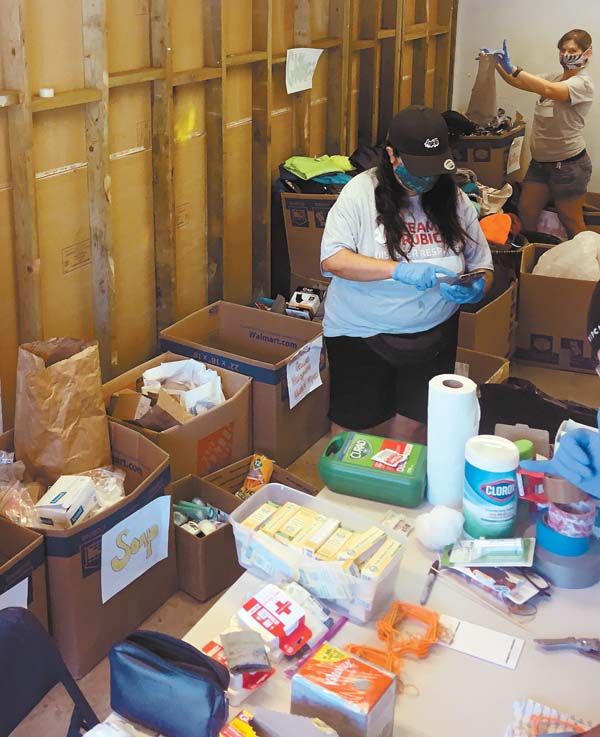
Volunteers work together to organize donations at the Maui Rapid Response hub in Kahului. Photo courtesy of Nicole Huguenin

A sign warns everyone to wear masks Thursday at a popular spot for homeless people and families to camp outside of Kanaha Beach Park in Kahului. The Maui News / MATTHEW THAYER photo
Vehicles and tents line Amala Place in Kahului on Thursday afternoon. With Kanaha Beach Park closed, the area outside the locked gates has become a popular spot for homeless individuals and families to camp. The Maui News / MATTHEW THAYER photo
Volunteers work together to organize donations at the Maui Rapid Response hub in Kahului. Photo courtesy of Nicole Huguenin
A sign warns everyone to wear masks Thursday at a popular spot for homeless people and families to camp outside of Kanaha Beach Park in Kahului. The Maui News / MATTHEW THAYER photo
Trending
A Maui Rapid Response team has stepped up to provide immediate help and assistance for homeless and unsheltered people amid the COVID-19 pandemic, but it's still a struggle to fill in the gaps.
Food and water are in high demand but have become less and less available for homeless people since county parks, restrooms, restaurants and other facilities have been shut down.
Five-gallon buckets have been in demand -- for toilets.
"Now, we've got people who don't have access to showers, they don't have access to washing their hands, they don't have access to washing their clothes -- they can take cold showers, but we're not talking soapy showers," said Melanie Undem, a Kihei homeless outreach worker who helped to create Maui Rapid Response.
"This should be the time where we should really be making sure people have showers and really making sure people have access to drinking water," she said.
Coincidentally, before the virus broke out, Undem had joined forces with Nicole Huguenin of Chilis on Wheels and Lisa Darcy of Share Your Mana in connecting with other volunteer-based groups, such as the nonprofit Maui Rescue Mission, to establish a team of support for homeless people. Hungry Homeless Heroes Hawaii, Ka 'Ohana Carter, Maui Makers and Team Rubicon also have offered support.
"This proved to be probably the greatest thing we did because months later we were thrown into a public health crisis," said Maui Rapid Response co-operator Huguenin. "Because we were already all out there, within days of everything happening, before they were shutting things down, we knew that it was going to get even worse."
Maui Rapid Response is not a registered entity but a collective group of organizations that are working together to help the homeless and the unsheltered people in each Maui region by providing hygiene trailer outreach, food distribution seven days a week and daily supply outreach -- all while wearing personal protective equipment.
"Each one of us has a unique set of skills that we bring to the table, which makes it collectively a much stronger organization," Maui Rescue Mission Executive Director Scott Hansen said last week.
From March 30 to April 4, about 1,400 people were served by the response team; that number grew to about 2,250 last week, according to Huguenin.
For the first two weeks of the organization, Huguenin's home was the main hub for donations, which filled up pretty quickly with community-donated supplies. The Maui Rapid Response hub was later moved to Kahului after a space was donated.
All donations, resources and information are shared between the Rapid Response components.
Emergency orders
When the state and county enacted stay-at-home and work-from-home policies, which prompted park, restaurant and other facility closures, "we just took away the tools that they (the homeless) had to be self-reliant and self-sufficient.
. . . Basic dignity and rights are being withheld," said Huguenin.
Access to food and water decreased by half, she said. To compound the situation, homeless people were being ticketed for violating emergency public health policies while having limited options to relocate, she said.
Oahu has implemented a Temporary Quarantine and Isolation Center for homeless in Iwilei, and Rapid Response hopes that land on Maui can be secured for similar use, she said.
Darcy said that Maui County created a massive public health crisis when it decided "to close public facilities such as bathrooms and access to water without any alternatives, in tandem with the continued policy to move people along who have no shelter."
After advocacy by Rapid Response, county restrooms at Kalama Park in Kihei, Pukalani Park and Lower Paia Park were reopened earlier this month.
Maui County Mayor Michael Victorino announced Thursday that coronavirus testing will be available at Ka Hale A Ke Ola Homeless Resource Center and Family Resource Center for homeless people in the wake of a positive case at Ka Hale A Ke Ola.
"We are going to different areas for which the homeless tend to hang out or live and bring them in," the mayor said. "It's their choice, but we're going to make it available. We want to cover every segment of our community."
Through observation and meeting multiple new faces, Rapid Response anecdotally estimates that the number of homeless people has gone up since the state's economy came to a virtual standstill due to the impacts of the virus.
"I'm just trying to get people bottles of water each day," said Darcy, whose nonprofit, Share Your Mana, offers help to those in need and resources to homeless people. "This number (of homeless people) will only be realized when it is too late and the already beyond maxed-out system is overwhelmed even further."
Feeding the homeless
In addition to helping run Rapid Response, Huguenin operates Chilis on Wheels, a nonprofit that offers vegan meals at local shelters, soup kitchens and open spaces. Other groups have been formed to help the homeless population.
Hungry Homeless Heroes Hawaii joined the Rapid Response team just one week after Steven Calkins and Brad Kukral created the organization. Starting with just 15 meals in a personal kitchen, Hungry Homeless Heroes quickly grew into a commercial kitchen donated for use by Blue Moon Cafe. They now cook about 300 meals daily for those in need islandwide.
"Every night our drivers are telling us we need more, we need more," Calkins said last week from the kitchen in Kihei. "Within the next month, more people are going to be displaced from their houses, and it's going to get even worse. . . . It's hard to get ingredients for that many people."
With 30 to 40 volunteers, about 45 meals go out to Kihei and Paia every night, between 100 to 150 to Kahului, around 35 to Wailuku and 100 to 120 to Lahaina.
"There were tourists here, thousands and thousands on a daily basis, so if (homeless people) weren't getting food handed to them by tourists, they were actually able to go into the garbage bins by restaurants and find food half-eaten," Calkins said. "Bathrooms were open all the time; showers, beach showers were working all the time, so it was a lot easier for them to live."
Amid the pandemic, Calkins said that his organization has been asked on several occasions for 5-gallon buckets or garbage bags to utilize as toilets.
"It's almost like we forgot that they are human beings," he said. "It's really, really, really sad. A lot of people say how worried (they are) that they can't work, and we're struggling to pay our bills and all that stuff, but a lot of these people are literally starving to go to the bathroom, literally starving to get washed up."
For phase two of the program, Calkins envisions a community garden and a kitchen run mostly by former or current unsheltered people. Five individuals have been slowly integrated into volunteer responsibilities thus far, he said.
Hungry Homeless Heroes is currently seeking donated to-go containers, chopsticks, gloves, face masks, leafy greens and any type of protein.
Calkins said they also need more volunteer drivers, who are "empathetic, compassionate and caring" to deliver meals and to make genuine connections. Volunteers also must be aware of and be able to comply with current safety and health guidelines regarding COVID-19.
Showers and bathrooms
Maui Rescue Mission operates a mobile bathroom with a shower and toilet, which are cleaned thoroughly after each use. Hansen said that his registered nonprofit also makes essential worker placards for the Rapid Response volunteers.
The trailer currently stops in Wailuku, Kahului, Kihei and Lahaina and is looking for a fifth location. Adding a spot to the rotation is challenging right now because there are "not enough days in the week and not enough people to run the trailer," Hansen said.
They also coordinate with the Salvation Army to provide showers once a week.
To combat the spread of the coronavirus, the usual mobile laundry services are discontinued for the time being.
"I initially shut the whole thing down, but when the county shut down all bathrooms and the parks, the people couldn't go in and use the showers," he said. "We decided that we needed to at least open up our bathroom to people. We needed to step up and do something."
Volunteers installed make-shift showers at Kanaha Beach Park, where more than 60 people are living out of cars, Hansen said.
"There's a lot more people who are becoming homeless that weren't homeless," he said. "A lot more people on the street -- there's a lot more people who don't have access to the showers they would normally take, which would be at the beach or a bird bath shower in a sink in a bathroom."
Maui Rescue Mission has supplied tents, sleeping bags and pots and pans, which are often left behind or damaged when homeless people are forced to relocate by law enforcement.
"It's very disheartening. A lot of these people want to shelter in place, they want to be able to stay in place and be safe, but they can't because they keep getting swept," Hansen said. "Also, if one of our homeless friends gets sick or tests positive, where can they go to quarantine themselves?"
Hansen said that fears over COVID-19 have led to a loss in volunteers, as well.
On-the-ground outreach
One volunteer has been working with Maui Rescue Mission since September and recently for Rapid Response's Lahaina homeless outreach seven days a week.
"Every day, I spend a few hours roaming streets and meeting our unsheltered friends. I load my car with food, water, first aid and clothes," Jelena Dackovic said last week. "I try to spend time with everyone I meet, building trust and listening to their needs or just being present with them and doing nothing but sit together and chit-chat."
Repeat visits are necessary for building respect and trust, Dackovic said. The regular contact and offers of support can lead the individual to take a step toward medical and psychological treatments or transitional housing.
She has been doing more outreach since the pandemic hit and has been wearing a mask at all the times while following social distancing guidelines.
"I am very aware of the situation, and I understand the risk of being a front-line worker during (the) pandemic, but I haven't for a second considered not doing it," she said. "Most, if not all the resources that were available for unsheltered populations are closed or very limited."
She hopes that Maui County will recognize what Rapid Response is trying to accomplish and that "we will be able to together use all power we have to overcome challenges and build a fundamental bridge between unsheltered individuals and available services and resources."
Undem has been a lifelong volunteer in the homeless community. She said she has an understanding of "what really is going on with the homeless and the unsheltered" and the many layers involved with coming up with solutions.
"There's no reason for people to be hungry, there's no reason for people to be unsheltered on this island, and we can do it. . . . There is a middle way," said Undem last week.
Recently, Undem said that a lot of homeless people were getting "rushed around by the police daily." She spoke to one individual who received seven citations. Citations are being handed out to those sheltering on private property, sitting on beaches or causing a disturbance.
"There's physical work, but there's a lot of emotional work," she said.
Undem quit her job to volunteer full-time to help homeless people. Two to three times a week, she restocks a donated service van with clothes, hygiene products, food, first-aid kits and tents from the Rapid Response hub to conduct daily outreach in South Maui.
During a biweekly visit to St. Theresa's Church last week to drop off items, she said that the church's Hale Kau Kau served 90 dinners and that she met 10 to 15 people "that I'd never even seen before" in one night.
Because of the pandemic, Undem said that homeless populations are moving around between regions, finding places like St. Theresa's where there are meals and resources.
"My van was not full enough to provide for everybody yesterday, and that's hard," she said. "Daily, I am not able to provide fully for people."
Donations sought include water, pop top canned goods, one- and two-person tents, tarps, AA and AAA batteries and medical supplies, like bandages and Neosporin. Other items include hygiene products, men's gym clothes and women's clothing, bedding, flashlights, reusable water bottles and plastic bags.
They may be dropped off at the Rapid Response central hub at 355 Hukilike St., Unit 104, from 10 a.m. to 4 p.m. Monday to Saturday.
Items also may be purchased via Maui Rapid Response Amazon Wish List online and shipped to 44 Kuinehe Place, Pukalani 96768. Donations also can be dropped off at the location.
"When we think about the collaboration of Maui Rapid Response, we are a collaboration of people ready to fill this gap while it's being figured out," Undem said. "We can't do this alone. It's an islandwide conversation and responsibility."
* Dakota Grossman can be reached at dgrossman@mauinews.com.