
Legislation aims to expand health care access, erase medical debt
Trending
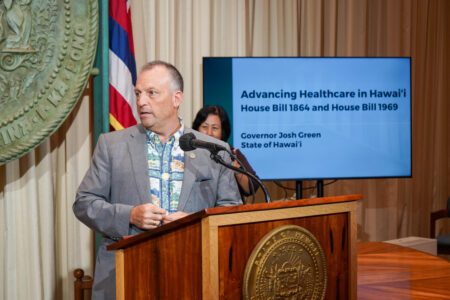
Gov. Josh Green has signed three measures aimed at expanding access to health care and creating a state program to forgive medical debt for eligible Hawaii residents.
Signed into law July 9, the measures include new insurance coverage requirements for fertility preservation, financial assistance for colorectal cancer screenings and a framework that could eliminate as much as $91 million in medical debt for up to 50,000 residents.
"It is with pride that we announce these measures which will truly transform the health and well-being of Hawaii," Green said in a news release. "Having spent years in the medical field, I have seen the gaps in the system. When our people are healthy and life-saving services are accessible and affordable, we will be a stronger and more adaptable Hawaii."
According to the governor's office, House Bill 1864, now Act 218, requires insurers, mutual benefit societies and health maintenance organizations to cover standard fertility preservation services for patients undergoing medically necessary treatments that may cause infertility.
Chemotherapy, radiation and some surgeries can damage reproductive organs and affect a patient's ability to have children. The new law is intended to ensure patients facing serious illnesses have access to fertility preservation before beginning treatment.
The requirement will apply to policies, contracts and plans issued or renewed after Dec. 31, 2026. The governor said it will make Hawaii the 22nd state to require such coverage.
"This is a historic moment for many of Hawaii's young cancer patients who, until now, not only had the heartache of receiving the devastating news of a cancer diagnosis, but also had the painful realization that the treatment for their cancer would result in the permanent inability for future fertility," said Dr. Michael Carney, chair of the Hawaii Society for Clinical Oncologists.
Green also recently signed House Bill 1969, now Act 219, which seeks to expand access to colorectal cancer screenings for residents who are uninsured, underinsured or ineligible for Medicaid.
The measure requires the state Department of Human Services to provide financial assistance to eligible residents and requires certain health insurance plans to cover medically necessary follow-up colonoscopies after a positive screening test without deductibles, copayments, coinsurance or other cost-sharing.
Colorectal cancer is the second-leading cause of cancer-related deaths in Hawaii and kills about 260 residents each year.
Senate Bill 3025, now Act 220, creates a Medical Debt Acquisition and Forgiveness Program through the state Office of Wellness and Resilience, which is now part of the Department of Human Services.
The program will allow the state, subject to available funding, to partner with a nonprofit organization to purchase outstanding medical debt from health care providers for a fraction of its face value and then cancel the debt.
State officials estimate the program could forgive as much as $91 million owed by up to 50,000 Hawaii residents.
The governor's office said about one in 20 Hawaii residents has outstanding medical debt listed on a credit report. The debt can delay medical treatment, hurt a person's ability to obtain housing or employment and contribute to stress and financial instability.
"Medical debt is one of the biggest drivers of financial ruin in Hawaii," said state Sen. Jarrett Keohokalole, chair of the Senate Commerce and Consumer Protection Committee and a co-introducer of the bill. "SB 3025 ensures that thousands of families in Hawaii don't have to choose between paying rent and paying off a hospital bill."
State Sen. Chris Lee, another co-introducer, said the state could use about $500,000 to cancel as much as $91 million in debt.
"This is probably the best return on investment ever -- $500k to cancel $91M in medical debt for 50,000 local families struggling to pay their bills," Lee said.
Residents will not apply directly for the debt-relief program, according to state Rep. Lisa Marten, chair of the House Committee on Human Services and Homelessness. Instead, qualified residents whose debt is purchased and canceled will receive a notice informing them that the balance has been erased.