
Crossing remains flashpoint in Kihei
DOE seeks to amend condition for overpass or underpass at school under construction
Trending
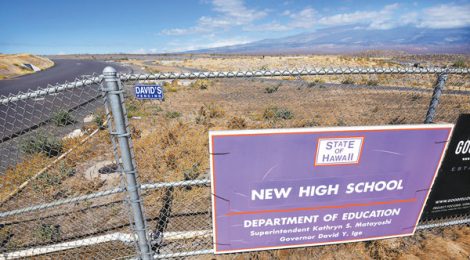
South Maui community members and state officials have reignited a debate over a safe pedestrian crossing for the long-anticipated Kihei high school.
The state Department of Education is seeking to pull back a condition of the school project that requires an overpass or underpass before the school can be opened -- something that residents had long advocated for and that the Land Use Commission had approved with the project back in 2013.
"I was shocked because legally the LUC had reaffirmed this position just last year," Andrew Beerer, a 15-year community advocate for the high school, said during testimony at a virtual LUC meeting Thursday. "I'm not surprised. It's been seven years now that the DOE has been trying to get out of this condition."
The crossing has been a hang-up for the 77-acre project that has been in the making for more than a decade. Although the school was initially targeted to open in 2014, conflicts over the pedestrian crossing could delay the school opening to 2024, according to testimony from state officials.
After hours of sometimes heated discussion that included allegations that state officials have not collaborated with the community, the LUC voted unanimously to defer the measure until the education and transportation departments can submit more data and do more community outreach.
"Some of the discussions are not backed up by evidence and material," LUC Chairman Jonathan Scheuer said before the vote. "I'm concerned about lack of consultation with the community."
Randall Tanaka, assistant superintendent for the DOE's Office of Facilities and Operations, said department and community interaction can improve.
"I will not take credit for my predecessors," said Tanaka, who assumed the post in January. "We need to do a much better job of that. And that's my promise to the community."
Citing improved safety, efficacy and cost, Department of Transportation Deputy Director Ed Sniffen made the case Thursday for a roundabout at the intersection of Piilani Highway and Kulanihakoi Street, as opposed to an underpass or overpass.
Grade-separated pedestrian crossings such as overpasses or underpasses "always feel better, again, if people use them," Sniffen said. "But that's not the data we have. The data we have are that people are going to avoid them because it's easier to cross 130 feet instead of taking 1,000 feet. . . . Nationally, the movement is to ensure safe, at-grade crossing because that's where people want to go."
Sniffen was adamant that the DOT will not support an underpass in the area, which includes a gulch that was created for hydraulic flow during flooding. Any time engineering is proposed for a waterway, there are several federal requirements.
"The consideration for an underpass at either of the two gulches will never be supported by DOT," Sniffen said. "It's not a responsible action to put people in a floodway."
He said the reason for the opening under the highway is for hydraulic flow in the event of 100-year storms, where engineers anticipate at least 7 feet of water. With that estimate, only 2 feet or so of clearance would remain for pedestrians.
"Someone might say, eh, it's only a 100-year storm so we have to assume this only once every 100 years," he said. "That's not the case. In the past five years, we've had three 100-year storms coming through."
Commissioner Dawn Chang said that when the LUC made its determination in 2019, DOT's present position was not known to the panel or to the DOE.
Historically, DOT has not supported roundabouts, Sniffen said, but with updated national and state data, at-grade crossings are considered safe to slow traffic and prevent vehicle-pedestrian collisions. The roundabout would slow highway traffic in South Maui to 20 miles per hour or less, he added.
"We are using this roundabout as the opportunity to be the buffer around the whole corridor," Sniffen said. "That's the intent of it. That's why the roundabout is there -- to make sure we have a 15 to 20 mph start for everyone in that corridor."
The roundabout would cost about $6 million, according to Sniffen. A typical underpass starts at $6.5 million but the Kihei high school underpass would need modifications to increase height or increase hydraulic opening, making it significantly more costly. Meanwhile, an overpass would be six times more expensive than an underpass, typically $30 million to $35 million.
If a roundabout is approved, it could be finished by next year, Sniffen said. If a pedestrian overpass or underpass is considered, the project could be pushed as far as 2024.
Community members testified Thursday that they strongly supported an underpass and a roundabout.
Randy Wagner, a Kihei Community Association member and architect, said that people are already using the Waipuilani Gulch as a walkway.
When asked if she had to choose between an underpass or a roundabout, State House Rep. Tina Wildberger of South Maui said "both."
"DOE is trying to subvert the wishes of the community that it serves," she said.
* Kehaulani Cerizo can be reached at kcerizo@mauinews.com.