
Solar panels power up UH-MC
UH-Maui College draws vitually all of its energy to run from the sun
Trending
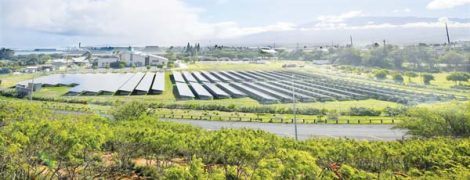
The thousands of photovoltaic modules at the University of Hawaii Maui College campus not only provides enough energy for the Kahului college but are a teaching tool for its students.
The 3,360 photovoltaic modules, along with its battery storage system, have made UH-MC a virtually "net-zero" campus, which means it produces as much energy as it uses, the college announced recently. In the UH system, UH-MC is the second school behind Leeward Community College, which became the first net-zero UH campus in July.
"As designed, with the solar PV arrays and battery energy storage fully operational, (the) Maui campus has the opportunity to draw all energy needed from the sun," said Michael Unebasami, UH Community College vice president.
University of Hawaii officials believe they are "one of the first" in the nation to be achieving net-zero status.
UH-MC Chancellor Lui Hokoana said: "This project speaks to our college's innovation, to our responsibility to our community. It provides a deeper experience for our students and shows what we can do to protect our values and our environment. It also offers a living laboratory for one of the most exciting and dynamic career paths through our Sustainable Science Management program."
For example, students in the Sustainable Science Management program have already conducted capstone projects related to the system including studying the financial savings, how large-scale solar might be implemented at Maui resorts, the life span of the panels and what to do with them once they need to be disposed of, Hokoana said.
He added that the students are also expanding their research into further reducing UH-MC's carbon footprint by cutting back on the amount of cars on campus.
The college is also working with Solar Energy International, which offers an online curriculum that will lead to nationally recognized renewable energy certifications, Hokoana said.
Last semester, the college had 16 students complete the online solar safety certification and 19 completed the Renewable Energy certificates.
These students will now have the necessary credentials to apply and assume jobs in two large solar projects that are being planned for Maui that will begin construction in the fall, Hokoana added.
The effort to making UH-MC more energy efficient and moving the campus to become net-zero started more than five years ago, according to Unebasami. He and other college officials began by looking at what equipment could be taken out or changed on the campus to reduce its energy consumption.
In 2011, UH Community College administration, which had been working on reducing energy costs for multiple campuses including Maui, executed an energy savings performance contract primarily with Johnson Controls.
Over the years that followed, UH-MC has seen installation of various PV projects with battery storage, including the parking lot installation at the Kahului campus' main lot as well as other areas of the campus.
The current project is in partnership with Johnson Controls and Mauo, a subsidiary of Pacific Current, and includes four UH community college campuses on Oahu.
In a power purchase agreement, Unebasami said the college purchases the renewable power produced on site by the equipment owned by its energy partners.
In the agreement, Unebasami said it pays its partners 24.5 cents per kilowatt-hour, comparing that to the 33 cents per kWh that is paid to Hawaiian Electric. The utility rate may fluctuate.
Still, it's too early to see what savings will be generated as the program just began this year, Unebasami said.
He added that the college will still rely on Hawaiian Electric, especially when renewable energy sources and its battery backup may not generate as much power as needed on campus.
The photovoltaic modules, which are located in a secure spot off of Wahinepio Avenue next to the college, can generate 1.58 megawatts of power, which is enough to service more than 200 homes annually and will offset greenhouse gas emissions equal to burning 4,400 barrels of oil a year, according to a news release. The project also includes 13.93 megawatt-hours of battery storage.
Hawaii became the first state in the country to make a commitment to achieve 100 percent renewable energy by 2045, UH said.
In 2015, UH and the Hawaii Legislature made a goal for the university system to be "net-zero" by January 1, 2035, meaning the system would produce as much renewable energy as it consumes across its 10 campuses.
* Melissa Tanji can be reached at mtanji@mauinews.com. Staff Writer Dakota Grossman contributed to this report.