State to tighten rules for jobless benefits
Starting May 30, claimants will need to start logging job searches
Residents receiving unemployment benefits will need to start documenting their job searches starting May 30 as the state pushes to get people back to work with the economy on the mend.
“At this point the public health measures we implemented and the success of our vaccine program have allowed us to begin to reenergize our economy,” Gov. David Ige said during a news conference Thursday. “With our pre-travel testing program in place, we’re seeing more people traveling to Hawaii, and as tourism has spiked, more employers are looking for people to fill positions.”
When travel slowed and businesses shut down during the early days of the COVID-19 pandemic, the state relaxed requirements that the tens of thousands of unemployed residents search for work in order to continue receiving their benefits. By May 2020, more than 230,000 unemployment claims had been filed, Ige said.
Unemployment rates skyrocketed across the nation, with Hawaii seeing some of the highest rates in the country. The pandemic and decline in travel hit Maui County’s tourism-dependent economy especially hard; in April 2020, the county hit a state-high 36 percent jobless rate.
Now, with travel surging, vaccination rates on the rise and the economy slowly beginning to recover, businesses are starting to hire again.
“We have heard from so many businesses who are trying to bring people back on,” said Pamela Tumpap, president and secretary of the Maui Chamber of Commerce. “Since March we’ve seen tremendous growth and businesses are rebounding. Many businesses, they’re calling employees and employees are not wanting to come back to work.”
Some workers are making more with unemployment benefits and the weekly federal “plus-up” of $300 than they did at their previous jobs, Tumpap said, a nationwide issue that’s spurred some states to opt out of the federal unemployment aid.
Not all workers are declining work for financial reasons; others are going back to school, while some have changed career paths completely. Others may find that their job no longer exists because of the pandemic, or that their old employers can no longer bring in as many workers.
“I’m not hearing that employers don’t want employees back,” Tumpap said. “It’s a question of, have they recovered enough to bring people back. In some cases, some businesses have made pivots. They’re incorporating new technology. They had to change the business model just to survive.”
Hawaii’s unemployment rate has slowly recovered since the shutdown last spring and was down to 8.5 percent as of Thursday, according to the Department of Labor and Industrial Relations. That means about 106,000 claimants will need to be looking for work starting the week of May 30 to June 5, department Director Anne Perreira-Eustaquio said.
Each Sunday, claimants must report three work search contacts they’ve made during the week and should keep a log for the state unemployment office to review. The work search requirement will not apply to claimants who are partially unemployed, who are attached to a union or who are receiving benefits under the Pandemic Unemployment Assistance program for gig workers and contractors.
Perreira-Eustaquio said that some things that constitute a work search could include registering on local hiring websites, visiting a job search board, filling out applications or meeting with employers for interviews.
Recognizing that the unemployment process is “extremely difficult,” she added that the state has created a new website at hawaiiunemploymentinfo .com to allow residents to get information on work search options and employers to report refusals of work by claimants.
The unemployment office has two programs that investigate work search requirements, Perreira-Eustaquio said. Staff will reach out to claimants on a random basis to put together an “individualized reemployment assessment,” which includes looking at their job contact log. The assessment will determine whether the claimant made valid job contacts. If it appears they didn’t, they will be referred to the Unemployment Insurance Division as possibly ineligible for benefits.
The department also has an internal audit section that contacts residents to make sure their claims are accurate and also looks at their job search contacts.
When investigating possibly ineligible claims, the department reaches out to the job contacts for verification, Perreira-Eustaquio said. She acknowledged that reinstating the work requirement will take some resources away from other areas, “but there are steps being put in place to be able to handle the additional workload.”
“I wouldn’t say (claimants) would expect additional delays,” she said. “We have brought on a contractor to help with adjudication issues. Our biggest issues right now are the overpayments as well as voluntary leave and . . . being released due to misconduct.”
Ige said that the state will not be suspending other federal unemployment initiatives, including the PUA program, the Pandemic Emergency Unemployment Compensation program and the $300 plus-up.
“As you know, the cost of living in Hawaii is higher than in other jurisdictions, and we have heard of many in our community who continue to struggle to find work and who continue to be unemployed,” he said. “So we do believe at this point in time, them continuing to receive the $300 benefit benefits the economy overall as well as their ability to pay rent and meet other expenses. We are evaluating that as the economy recovers and as more people get back to work.”
For workers who are struggling to find a job, Tumpap pointed out that there are programs such as Remote Ready Hawaii to retrain people for different careers. She pointed out that in the past when other industries or businesses shut down, it was often the visitor industry that picked up the slack.
“If they’re not able to fully bring back all of the jobs they had before, we’re going to need to retrain people and invest in diversification, which we should be doing anyway,” she said. “But that’s a long-term investment, and it takes time, and of course, we need to attract the right industries that leverage our assets but also protect our environment and our quality of life and core values here in Maui County.”
* Colleen Uechi can be reached at cuechi@mauinews.com.
-
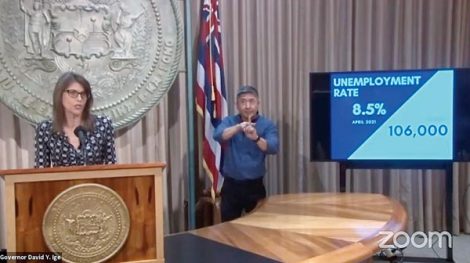
- Anne Perreira-Eustaquio, director of the Department of Labor and Industrial Relations, explains during a news conference on Thursday how the department will monitor and check in with unemployment insurance recipients to ensure they are searching for jobs. The Maui News / COLLEEN UECHI photo
-
- The Maui News / COLLEEN UECHI photo
Local News
Rotary Club of Wailuku to host Stormwater Maui
The Rotary Club of Wailuku will host Stormwater Maui for a presentation on stormwater management and the ...

Seal pupping season is underway; state urges public to keep distance, report sightings

Operating Engineers Local Union No. 3 endorses Bissen for re-election
SNAP hot foods waiver approved for Hawaii households impacted by kona low storms
The U.S. Department of Agriculture has approved a temporary waiver allowing SNAP participants in Hawaii to use ...
MEMA, others to conduct training exercise on Thursday in Kahului
A multi-agency, full-scale training exercise will be from 6 a.m. to 5 p.m. Thursday in Kahului, according to the ...