
Report: Maui County’s economy catching up
Tourism-related industries still hurting for workers even as demand soars

Owner Dan “Stanton” Cohen gives a tour of some of the memorabilia on display at Alice in Hulaland in Paia Thursday. The Maui News / MATTHEW THAYER photos

Alice in Hulaland Manager Danel Delost demonstrates the sound of one of her favorites among the store’s ukuleles Thursday.
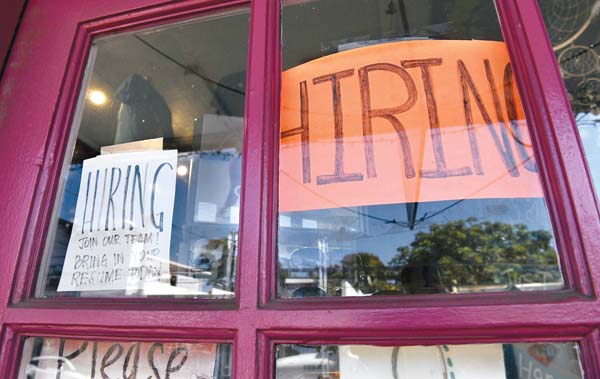
Signs posted at Alice in Hulaland announce the Paia landmark store is looking to hire employees Thursday.
Owner Dan “Stanton” Cohen gives a tour of some of the memorabilia on display at Alice in Hulaland in Paia Thursday. The Maui News / MATTHEW THAYER photos
Alice in Hulaland Manager Danel Delost demonstrates the sound of one of her favorites among the store’s ukuleles Thursday.
Signs posted at Alice in Hulaland announce the Paia landmark store is looking to hire employees Thursday.
Trending
In the maroon-framed windows of Alice in Hulaland's storefront in Paia town, a bright orange "hiring" sign makes a plea to potential workers passing by.
Owner Dan "Stanton" Cohen said he's not the only Paia merchant operating with a skeleton staff.
"It's a real challenge because there is nowhere for them to live that is reasonable," Cohen said Thursday. "The rents have gone up so much in the last five years, it's crazy. I've been looking for help for years. Every restaurant in town opens late and closes early because they can't find staff."
Cohen's dilemma is one facing many Maui businesses as jobless rates improve but employers still struggle to find workers -- especially in the lower-wage and tourism-dependent sectors -- as the pandemic pushed many people to leave Maui, retire or change jobs altogether.
Maui and Kauai counties, which took some of the hardest economic hits from the pandemic because of a heavy reliance on tourism, are finally catching up with Oahu and Hawaii island in terms of payroll employment as the labor market steadies, and the unemployment rate across the state is now below 3.5 percent, according to a University of Hawaii Economic Research Organization forecast released today.
But even as the labor market gets back to normal, economists are noting the effects of the pandemic on workers from different industries, income class and age group.
Workers in tourism-related industries have unsurprisingly seen the biggest wage gains over the past year as visitors flock back to the islands. Hourly wages for nonfarm jobs rose an average of 4 percent over the past year, but 16 percent for accommodations and food industry jobs, according to the report.
"If you look at visitor numbers, Maui, Kauai and Big Island are basically completely back to pre-pandemic levels," UHERO Executive Director Carl Bonham said Thursday. "Oahu is still lagging because of the lack of Japanese visitors. But they didn't lose as many jobs to start with."
The jump in tourism-related wages may reflect a worker shortage in the industry that's playing out across the country -- a study by Harvard University's Opportunity Insights Lab found that 20 percent of low-income employees, which dominate the leisure and hospitality workforce, are still missing from the pre-pandemic labor force, according to the report.
Maui and Kauai counties lost a larger share of their payroll jobs during the worst stretch of the pandemic from April to the summer of 2020, with the payroll job losses on Maui around 10 percentage points larger than they were on Oahu, Bonham said.
"Even with the bounce back in tourism, it just takes time to sort of recoup those," Bonham said. "And then the other thing you have to remember is some of those workers who lost jobs in tourism left ... and you can't hire someone who's not on the island, not very easily, at least not for food service or retail or things like that."
Tourism continues to be the factor that local economists believe will buoy the state in a U.S. recession. But Bonham said earlier predictions of a U.S. recession hitting in early 2023 are now being pushed to later this year as the nation's economy "has held up even stronger than we had been thinking it would."
Unfortunately, even as the economy has seen continued growth in jobs, income and consumption -- which has translated into stronger U.S. visitor arrivals to Hawaii than economists were expecting this winter -- that also suggests that the Fed will raise interest more.
"We're in this world where good news is bad news," Bonham said.
Hawaii's prospects still look better than those of the nation as a whole. Inflation in Hawaii has been less severe than on the Mainland, "but has still taken a big bite out of purchasing power," the report notes. Real personal income declined more than 6 percent last year, though it will pick back up as inflation continues to recede.
The costs of everyday items is also improving -- oil prices have reversed all of their 2022 gains, and food prices are also expected to decline as global supply conditions improve. Consumers "absolutely" could see some relief, "but it could vary by product," Bonham said.
"The near-term outlook is not without risks, particularly more aggressive Fed tightening," the report says. "Still, our state's relatively healthy footing puts us in a position to begin the hard work of addressing longer-term challenges. These include the visitor experience, questions of tourism capacity, housing cost and availability, our aging population, and adjustment to climate change."
* Colleen Uechi can be reached at cuechi@mauinews.com. Staff Writer Matthew Thayer contributed to this report.