Keeping traditional navigation alive is a voyage of its own
Sesario Sewralur was still a little boy when his father, the legendary navigator Mau Piailug, embarked on a historic voyage from Maui’s Honolua Bay to Tahiti in 1976 and helped revive an endangered art.
“Skills of navigation was not shared with others, it was just passed down within the families,” Sewralur explained. “That’s how we lost all these schools of navigation. My father step outside the box and teach the navigation to the Hawaiians.”
Sewralur offered insight on the tools of his trade and the remarkable achievements of Polynesian ocean voyagers during the “Gathering of the Voyagers” celebration at the Fairmont Kea Lani earlier this month.
Now a legendary navigator himself, Sewralur teaches traditional voyaging using the stars, the sun, wind, clouds, seas, swells, birds and fish. His knowledge was passed down through the generations of navigators in his family, from his great-grandfather to his grandfather and on to his father.
Piailug taught these traditions to the Polynesian Voyaging Society, which helped revive the art of voyaging, which was nearly lost in Polynesia after colonization. During the Japanese colonial administration of the 1920s, Indigenous navigating knowledge almost disappeared because interisland travel was forbidden.
Piailug revived the practice in 1976, with the historic voyage from Hawaii to Tahiti. He also helped train renowned navigator Nainoa Thompson, now head of the Polynesian Voyaging Society.
In times before, Sewralur said, there were 18 schools of traditional navigation — now there are only two left.
Today, Sewralur carries on the tradition at Palau Community College, where he instructs 25 students, including Cseng Li from Taiwan, who attended the Wailea talk on Oct. 14.
Sewralur is from the Micronesian island of Satawal, “which is three miles long and a mile and a half wide. Back home it’s all small atolls, and you have to be a very good navigator to find those islands,” he told a packed audience at the Fairmont.
Sewralur began learning how to navigate at the age of 4.
“We learn the star compass and the name of the stars. You have the storm stars for each month. Storm stars tell you when it’s good weather to sail, when you see the storm stars rising or setting. You need to know all the references. You have the swells, the animals in the ocean, the number of fishes, or a number of dolphins. Those are the references that we use to guide us in the ocean,” he explained.
First arriving in Hawaii with his father in 1980, Sewralur later sailed “down to the Cook Islands with Maoris and Tahitians. They were asking me to help them with navigation. The same year I sailed to Mururoa Atoll in Tahiti, where they test the nuclear bomb. I went there to protest against a nuclear test.”
In an initiation, called the pwo ceremony, in Palau in 2019, Sewralur was honored with the title of grand master navigator.
Asked about future plans, he said, “We are in the process of making an exchange between Maui and Micronesia. Sail from Micronesia to here and bring the students to learn the skills of navigation. Not only Maui, but I think Taiwan is also trying to be involved in this program.”
The origins of Pacific migration depend on who you ask, said Kahu Kapi’ioho’okalani Lyons Naone of Maui, who shared stories of ancestral wisdom during the Gathering of the Voyagers event. Born and raised in Kipahulu, Naone is a revered kahuna la’au lapa’au (master of plant healing) and kahuna kuhikuhipu’uone (master of geomancy and earth sciences).
“Somewhere about 2,100 years ago,” Naone explained, “a kahu, who spent his whole life just looking up at the sky, went to the ho’okele, the navigator and the canoe builder, and the leaders, and he said, ‘I have seen a star. It is time for us to move’.”
This was in the area known today as the Marquesas Islands. The ancient kahu, said Naone, pronounced: “We need to take our hook and pull that star, and when that star arrives, the islands called Lehua will come to us.”
Naone noted that “modern archaeologists have a different story. This guy did some research and decided that you folks were here only 700 years. Our kupuna tell us a different story. Stories are different.”
Another story, he reported, began about 4,000 years ago, when “a group people from the islands they call Mu,” were informed they needed to move and they were told to start preparing.
“We know them as the Mu’ai Mai’a,” Naone said, explaining that this means “the banana-eating people of Mu.” “They were the people that were the residents of these islands 2,000 years before we came.”
Naone went on to reveal an extraordinary encounter with a Native elder in a Central American village in the 1980s. “Everyone in the village were la’au lapa’au practitioners. On the last night, just before the sun came up, one of the leaders in the village came and woke me up,” Naone said.
He was taken up a mountain to a hidden cave with a sand floor.
“We were not close to the ocean, but it was sand,” he recalled. “And on the wall, there were four petroglyphs. Four Polynesian canoes. How can there be Polynesian-looking canoes in the middle of Central America? I said, what is this? He said, ‘that’s our ancestors. That’s how we came, about 2,000 years ago, from Mu.'”
Mystified by the discovery, back at the village, Naone pulled out a world map. “I saw the guy coming, and he walks by, and he said, ‘Mu.’ Is it real? Is it true? Yes.”
-
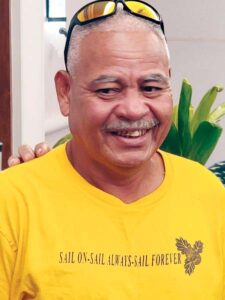
- Sewralur
-
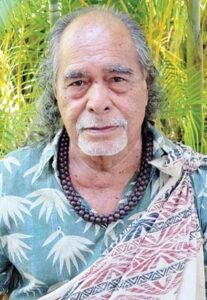
- Naone
Local News
Haiku man killed in motorcycle crash in Makawao
A 48-year-old man from Haiku died in a motorcycle crash Wednesday night in Makawao. The man's name has not yet ...
Construction Industry of Maui awards scholarships

2025-26 MIL ALL-STARS: Swimming and Diving
County seeks input on plans to restore Lahaina Royal Complex

Jack Johnson, Bull Kotter documentaries highlight festival