
U.S. Trade Representative meets with MEO leaders, Sens. Hashimoto, Kouchi

U.S. Trade Representative Katherine Tai visited Maui Economic Opportunity in Wailuku on Wednesday, Feb. 21, for a listening session that included state Senate President Ron Kouchi, state Sen. Troy Hashimoto and MEO CEO Debbie Cabebe. — Photo courtesy MEO
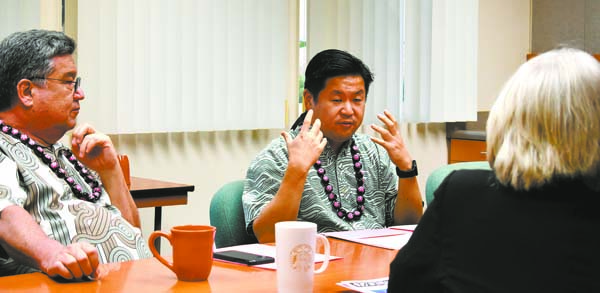
State Sen. Troy Hashimoto, who represents Waiehu, Wailuku, and Waikapu, makes a point during a meeting with U.S. Trade Representative Katherine Tai. State Senate President Ron Kouchi looks on. — Photo courtesy MEO
U.S. Trade Representative Katherine Tai visited Maui Economic Opportunity in Wailuku on Wednesday, Feb. 21, for a listening session that included state Senate President Ron Kouchi, state Sen. Troy Hashimoto and MEO CEO Debbie Cabebe. — Photo courtesy MEO
State Sen. Troy Hashimoto, who represents Waiehu, Wailuku, and Waikapu, makes a point during a meeting with U.S. Trade Representative Katherine Tai. State Senate President Ron Kouchi looks on. — Photo courtesy MEO
Trending
U.S. Trade Representative Katherine Tai visited Maui Economic Opportunity's Wailuku offices Wednesday, Feb. 21, for a listening session about the wildfire recovery and assured that "in this quest and in this challenge you are not alone ... imagining what the future looks like in a world that feels kind of broken."
In addition to MEO CEO Debbie Cabebe and her leadership team, state Senate President Ron Kouchi, Maui County state Sen. Troy Hashimoto, and Melissa Unemori Hampe and Keapo Bissen from Skog Rasmussen attended the afternoon meeting.
Ambassador Tai was sworn in as the 19th U.S. Trade Representative in March 2021. As a member of President Joe Biden's Cabinet, Tai is the principal trade adviser, negotiator and spokesperson on U.S. trade policy.
She also is the co-chair of the White House Initiative on Asian Americans, Native Hawaiians and Pacific Islanders. "Just coming here and seeing the community and the diversity that's here and the complexity" has been valuable, she said.
"Maui, Lahaina, Hawaii are very, very much on our minds," she continued.
Touring Lahaina was "humbling," Tai said, adding that "nature's will" destroyed some homes and not others in the same vicinity. "Not everyone was affected equally."
"The devastation happened over the course of 40 minutes or so, but it's going to take ... more than a decade to rebuild," she said.
Tai spent most of the hour listening. Cabebe explained MEO programs supporting those impacted by the fires--Maui Relief TANF Program for families with children, National Dislocated Worker Grant and Maui Business Bridge Grants program. She also offered insights into housing, workforce and business revitalization issues.
Kouchi noted the differences between the recovery from the two hurricanes that struck his home island of Kauai and the wildfires in Lahaina and Kula. Cleanup and rebuilding of homes began shortly after the hurricanes with a steady progression toward recovery. Not so in Lahaina where the recovery still is in the cleanup stage seven months after the wildfires with major issues of infrastructure, toxicity of the air and rubble and other problems to resolve before the rebuilding can begin.
Hashimoto told Tai that it is critical for the Federal Emergency Management Agency to build permanent housing, something the agency doesn't do normally. With the rental housing market "out of whack," this is a necessary step to keep the workforce from leaving the island, he said.
"Having this meeting with MEO is important, because they are tried and true. They are going to be here once the private money has dried up, and they are still going to have to try to deliver services," Hashimoto told Tai.
MEO will seek out available federal funds to fill gaps.
"There's probably a lot of services now, but we are probably going to see that cliff starting to happen," Hashimoto said. "It's going to be scary, but MEO is going to be that partner for us."
About Maui Economic Opportunity
Maui Economic Opportunity, Inc., is a nonprofit agency that's part of the national Community Action Partnership network, whose goal is to help low income individuals and families and disenfranchised people help themselves and transform their lives.
Chartered in 1965, MEO offers more than 40 programs that assist low income people, kupuna, youths, persons with disabilities, immigrants and other disenfranchised individuals countywide.
MEO runs the Human Services specialized transportation program for health and dialysis appointments, after-school and youth sports activities and more; and the Maui Bus paratransit system; Head Start preschools and Kahi Kamali'i Infant Care Center; as well as programs that offer kupuna socialization and information; rent, mortgage and utility assistance; Spanish interpretation and translation; entrepreneurial and financial classes and support, including microloans; inmate reintegration into the community after release; youth drinking, drug, smoking, bullying and suicide prevention; and employment training and placement.
* For more information about the entire array of programs, visit meoinc.org or call (808) 249-2990.