Land restoration begins at Olowalu with fire debris now at permanent disposal site
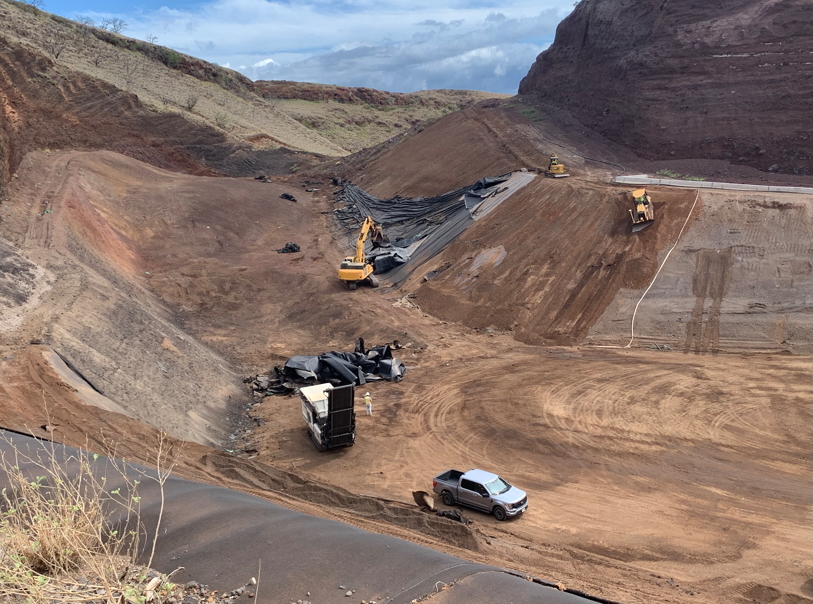
The U.S. Army Corps of Engineers is working with its contractor at Olowalu to restore the temporary debris site used to store ash, soil, and other related-2023 wildfire related material. Photo courtesy Maui County
Work has begun to restore the land at Olowalu used as a temporary transfer site for Lahaina Wildfire debris.
According to the county, the debris, including 400,000 tons of ash, soil and fire-related material, has been transferred to the permanent location in Central Maui. The debris came from 149 commercial and 1,390 residential properties.
Maui County Mayor Richard Bissen said that with the transfer complete, the debris now rests in a protected area that will remain undisturbed.
“This milestone holds deep meaning for our community,” Bissen said in a statement. “The debris from Lahaina represents more than the physical remnants of what was lost — it carries the memory and spirit of a place and its people.”
As part of the restoration work, the U.S. Army Corps of Engineers and its contractor, Environmental Chemical Corporation plan to remove the liner, leachate system and other temporary infrastructure at the site at Olowalu.
The county said residents will continue to see trucks hauling restoration materials and debris for approximately 10 weeks, but the blue-and-white “Maui Wildfire Debris” identification stickers that were placed on the trucks will be removed or covered.
The county said restoration work will include efforts to restore the temporary site to its original state as closely as possible, as well as making road repairs and installing drainage and safety features.
The Army Corps of Engineers and its partner also plan to remove the temporary infrastructure that was installed along portions of the haul route.
The temporary site was established in early 2024 as an interim holding site to contain Lahaina wildfire debris while a permanent site was being identified.
The Army Corps of Engineers said the temporary site was built with environmental safeguards, including geotextile layers, a welded liner, leachate collection systems and groundwater monitoring wells.
Eventually, the Corps and its partner plans to conduct soil and groundwater testing to confirm that the protective systems functioned as designed and that no contamination reached the surrounding environment.
Local News
Park Maui to launch July 15 at Kamaole Beach Parks I and III
Maui, Higashimatsushima formalize friendship built on shared experience, forged by students

Paddle Imua brings world-class athletes together in support of children with special needs

Native plants help rebuild dunes at Baldwin Beach

New mural to be unveiled in Paia Sugar Mill