
Hui asks developers to stop digging for burials
Members call for less invasive measures to find potential iwi
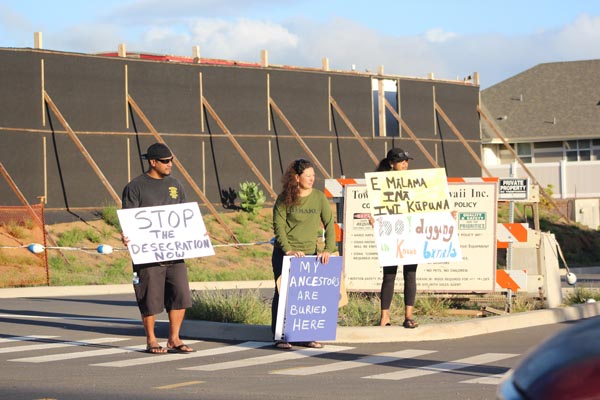
Jacob Kaneakua (from left), Noelani Ahia and Laura Johnson hold signs calling for a halt to ground-disturbing activities outside the Towne Realty Parkways subdivision in Maui Lani on Monday morning. Developers are starting work to identify potential burials on the Phase 6 site of the development, but cultural descendants and other protectors of iwi kupuna were concerned that the digging would actually disturb burials in the process. The Maui News / COLLEEN UECHI photo
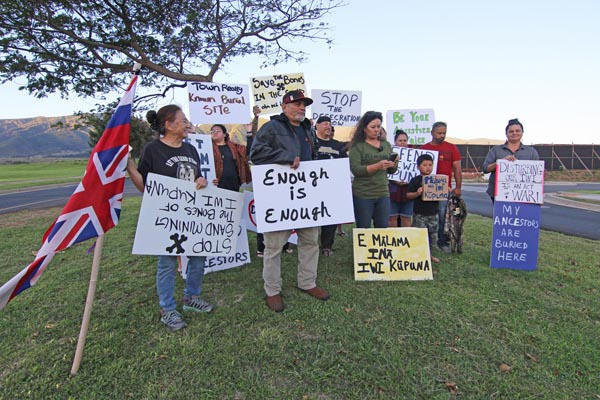
A group of iwi kupuna protectors that include cultural descendants and members of Malama Kakanilua, gather outside the Maui Lani housing development Monday to ask developers to stop digging on Phase 6 of the project. The Maui News / COLLEEN UECHI photo
Jacob Kaneakua (from left), Noelani Ahia and Laura Johnson hold signs calling for a halt to ground-disturbing activities outside the Towne Realty Parkways subdivision in Maui Lani on Monday morning. Developers are starting work to identify potential burials on the Phase 6 site of the development, but cultural descendants and other protectors of iwi kupuna were concerned that the digging would actually disturb burials in the process. The Maui News / COLLEEN UECHI photo
A group of iwi kupuna protectors that include cultural descendants and members of Malama Kakanilua, gather outside the Maui Lani housing development Monday to ask developers to stop digging on Phase 6 of the project. The Maui News / COLLEEN UECHI photo
Trending
KAHULUI -- A hui of iwi kupuna protectors called on Maui Lani developers Monday to stop digging for burials and instead use less invasive measures to find potential iwi on site.
About a dozen residents, including members of Malama Kakanilua, gathered in front of the entrance to the Towne Realty Parkways subdivision where "ground truthing" activities were scheduled to start Monday.
The purpose of the work, which was authorized by a judge earlier this year, is to identify potential burials at the Maui Lani Phase 6 site. However, Malama Kakanilua members were worried that developers would actually disturb burials in the process.
"We'd like to call out to the developers and ask them to do the right thing, to do the pono thing, and to stop digging, or better yet, don't start digging today even though that's your scheduled plan," said Jennifer Noelani Ahia, a recognized cultural descendant to burials found in area. "Please, these are our kupuna. These are our loved ones who are resting. They've been disturbed enough."
In February, Ahia filed a complaint in 2nd Circuit Court that put a temporary stop to construction of Maui Lani Phase 6. The complaint contends that the state Historic Preservation Division, Maui County and landowner HBT of Maui Lani knew the project site contained Native Hawaiian burials and yet failed to protect them.
Ahia's attorney said during closing arguments in March that the 2007 archaeological inventory survey done for Phase 6 was inadequate, identifying just five burials, possible burial sites and burial features. During work at the site from 2008 to 2016, HBT found more than 170.
Daniel Morris, an attorney for the state, said at the time that archaeological surveys were "not designed to find every shred of every historical property on the development site." And Michael Carroll, an attorney for HBT, said that the project was more than 75 percent complete, and that to halt it would cost HBT millions of dollars and delay much-needed housing.
In April, 2nd Circuit Judge Joseph Cardoza issued a preliminary injunction to stop work at the site until more protections could be put in place. Cardoza then ordered that ground-penetrating radar analysis be done on remaining work areas in Phase 6.
The order directs workers to use manual digging at all times, and allows for a small backhoe to remove the top compacted layer and/or fill layers. Manual digging must be used within 2 feet of an anomaly, and no mechanical equipment can be used within 2 feet of an anomaly.
"Which in terms of archaeological practices is an improvement," Ahia said Monday. "However, careful desecration is still desecration."
Ahia said that she wants the developers to do a complete AIS for the site. She explained that everything that's found during the survey process is considered "previously known burials" and goes to the Burial Council, which includes representatives from around the island. But everything found after the survey process is considered an "inadvertent find" that goes to the State Historic Preservation Division.
"What we're asking for that's new and different is a noninvasive AIS, because there are new technologies that have evolved since the laws were first created and the AIS process first evolved," Ahia said. "For example, we have things like ground-penetrating radar. There are statistical analyses, LIDAR and ways to look at a burial ground in context instead of as an isolated individual burials."
Because Ahia's case is still moving through the courts and no trial date has been set yet, Ahia was concerned that the judge hadn't had a chance to review all the evidence, and that allowing digging on the site would be "putting the cart before the horse."
"There's way more information that has to be gathered," Ahia said. "So to allow digging is really just to benefit the developer at this point so they can continue while we're in the case. But the point of the injunction was to stop everything until all the facts are brought forth."
Andrew Chianese, an attorney for HBT, said Monday that the company had no comment. He had not responded as of Monday evening when asked to confirm that "ground truthing" work had begun.
Maui Lani is a master-planned community that will total 3,700 homes upon completion, and most of the area around Phase 6 is already developed, Carroll said in March. Phase 6 is a single-family residential development of 45.2 acres between The Dunes at Maui Lani Golf Course and Maui Lani Parkway. It's being developed in four increments. Homes have already been built and sold in the first three increments; Ahia's complaint centers on the fourth increment, which had nearly completed rock grading back in March and was moving forward with utility installation.
Johanna Kamaunu, who represents Wailuku on the Maui Lanai Island Burial Council, said Monday that HBT's attorneys came to a meeting earlier this month and said they had a court order allowing them to dig and investigate "anomalies" on the site.
"I said, 'At what point does your court order diminish our rights to protect our iwi?' '' Kamaunu recalled.
She told the attorneys that if they disturbed any iwi, everyone from "the man in the hole to the corporate officer and this attorney who says they're going to go ahead and do it" would be penalized $10,000 each.
"I'm not sure that message got through," Kamaunu said.
Clare Apana, a member of Malama Kakanilua who came Monday, said the Maui Lani area used to have two parallel sand dunes with iwi kupuna that are "now flattened out here completely."
"It's time to stop intruding upon our iwi kupuna, especially in known burial grounds as this one is," she said.
Cody Nemet Tuivaiti said that nobody thinks about the burials as people.
"We look at them as a means to get to where we need to get to," he said. "But we need to understand that these are the ancestors of our lands. These are the backbones of these lands. These are the vertebrae of this aina, and we got to malama them."
* Colleen Uechi can be reached at cuechi@mauinews.com.