
Hōkūle‘a celebrates 50th anniversary: Double-hulled sailing canoe to visit roots in Taiwan in 2027
Trending
Molokai resident Penny Rawlins Martin recalled that months before the maiden voyage of the double-hull sailing canoe Hōkūle'a to Tahiti, she and a number of other crew members realized preparing the vessel required more than working on weekends.
"We pretty much quit our jobs and left our families and moved to Sand Island on Oahu to work on the Hōkūle'a," Martin said.
Their dedication and sacrifice is being honored this month, which marks the 50th anniversary of the Hōkūle'a's journey from Hawaii to Tahiti using traditional navigation methods.
The voyage began on May 1, 1976, from Maui's Honolua Bay. Crew members of the Hōkūle'a arrived in Papeete Harbor, Tahiti, on June 4, 1976, where more than 17,000 people had gathered to welcome them.
The success of the voyage debunked the notion that Hawaiians settled in the Hawaiian Islands by accident and highlighted their ancestors' navigational skills.
The Hōkūle'a, supported by the Polynesian Voyaging Society, helped launch the Hawaiian Renaissance, a rebirth of Hawaiian culture and language. It also helped to inspire other Pacific cultures in Tonga, the Cook Islands and New Zealand to build voyaging canoes.
"I feel happy about how far the Hawaiian culture has come back," Martin said.
In 2007, a Hōkūle'a crew traveled to Satawal in Micronesia, accompanying the voyaging canoe Alingano Maisu as a gift to Master navigator Mau Piailug.
During the same visit, an ailing Piailug inducted more than a dozen islanders -- including Maui resident Chad Baybayan, Big Island residents Shorty Bertelmann and Chad 'Onohi Paishon, and Oahu residents Bruce Blankenfeld and Nainoa Thompson -- into the ranks as Pwo master navigators.
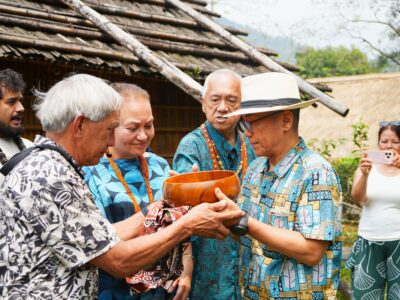
Polynesian Voyaging Society Chief Executive Officer Nanoa Thompson (left) presents a koa bowl as a gift to Giljegiljaw Pakedavai, director of the Indigenous Peoples Cultural Development Center in Pingtung, Taiwan, on April 9. Photo courtesy Polynesian Voyaging Society
Crew members from Maui
Three crew members of the original Hōkūle'a crew came from Maui County and were from fishing families, including Martin, Abraham "Snake" Ah Hee and Sam Kalalau. Martin recalled making a canoe out of materials from a tin roof as a child.
She started paddling a canoe before she was a teenager. Ah Hee of Lahaina was known to ride 15-foot waves when the surf was up at Honolua Bay in north Maui and learned to read the winds from his father to determine where to lay nets for opelu or mackerel.
"They didn't go out when the wind was too strong," he said.
Kalalau from Hana was the best steersman among the crew.
Kalalau, who died in 2008, was described as having a rock steady hand on the steering paddle. He trained other crew members and was well-respected for his knowledge of fishing in rough waters off Maui’s windward coast.
Kalalau was on the crew that sailed from Hawaii to Tahiti, and Martin and Ah Hee were on the crew returning to Hawaii.
Martin recalled crew members living in two shipping containers at Snug Harbor on Sand Island as they prepared the Hōkūle'a for its maiden voyage to Tahiti.
The crew went into the mountains to cut trees for the rails for the 62-foot Hōkūle'a, and they lashed rope to assemble its double-hulled design in the traditional way with no nails.
Before the departure, Hawaiian cultural expert Sam Ka'ai of Maui carved and installed the male and female guardians or ki'i on the stern of the Hōkūle'a.
At night, Mau Piailug, a master navigator from Micronesia, shared his knowledge of traditional navigation methods with the crew, including the position of stars that would guide them thousands of miles.
"In the evening, he showed the stars to us," Martin recalled. "He gave us an introduction to navigation."
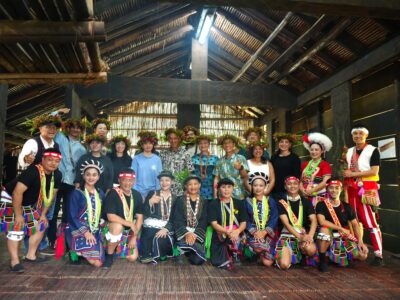
The indigenous Amis tribe of Taiwan greets Polynesian Voyaging Society official Nainoa Thompson (top center) to the National Indigenous Culture Park in Pingtung, Taiwan, on April 9. Photo courtesy Polynesian Voyaging Society
Scientists confirm Pacific voyaging
There were indications of the long-distance navigation prowess of Hawaiians in the 1970s. The channel between Lanai and Kahoolawe is named "Kealaikahiki," (Pathway to Tahiti), and there is an ancient chant about the high chief Mo'ikeha from Tahiti who visited the Hawaiian islands.
The evidence continued to grow. Two years after the Hōkūle'a voyage to Tahiti, a Bishop Museum archaeologist discovered part of a 23-foot double-hulled sailing canoe in the Marquesas, supporting the theory that Polynesians were long-distance ocean voyagers.
Archaeologists and linguists were able to connect the migration of the Lapita people, Neolithic Austronesians, with their distinct pottery through Melanesia and Micronesia to Tonga in Eastern Polynesia.
With its forest of tall trees, Tonga, Samoa and Fiji were identified as places where large double-hulled sailing canoes were built, enabling crews to venture thousands of miles into the Eastern Pacific, starting about 900 B.C.
In the early 2000s, scientific studies through DNA analysis traced the Polynesian migration in the South Pacific back to a common ancestral link of natives living on Taiwan about 3,000 to 5,000 years ago.
The Polynesian Voyaging Society and Kamehameha Schools participated a cultural exchange with Taiwan last month in anticipation of a planned visit by the Hōkūle'a and its sister sailing canoe Hikianalia in spring 2027.
"For us, coming to Taiwan feels like a homecoming," said Randie Kamuela Fong, executive cultural officer at Kamehameha Schools. "We came with humility to listen, to learn and to reconnect with the communities who have carried their ancestral traditions and knowledge forward."
In Pingtung, the delegation visited the National Indigenous Culture Park, where they were received with a traditional ceremonial welcome by the indigenous Amis tribe.
A key part of the journey included traveling to Lanyu, also known as Orchid Island, where the delegation spent time learning from the Tao people about ancestral voyaging traditions and ocean-centered ways that continue to be a part of their daily life.
Polynesian Voyaging Society Chief Executive Officer Nainoa Thompson, along with two next-generation navigators, shared Hawaiians' knowledge of traditional navigation and asked for guidance and support from the Taiwanese.
"We are here because we need your guidance, and we need your support to come to our homeland of 6,000 to 7,000 years ago, where the first genius of deep-sea voyaging canoe construction began," Thompson said. "This family of the canoe, this family of the ocean, comes to your land to learn. At the heart of your culture is love, and we have felt that deeply in these past few days."

Some Maui County residents have been an integral part of the Pacific and worldwide voyages of the Hawaiian sailing canoe Hōkūle'a. The late Maui resident Chad Baybayan, a leader in the voyaging society, was inducted as a Pwo navigator by Master navigator Mau Piailug along with four others from Hawaii in 2007. Photo courtesy Gary Kubota
Taiwan, a part of Pacific voyage
The Polynesian Voyaging Society's Moananuiākea Voyage began in 2023 as a multi-year circumnavigation of the Pacific connecting ocean communities across more than 30 countries and nearly 100 Indigenous territories.
The planned arrival in Taiwan in spring 2027 represents a milestone in reconnecting the Austronesian world through voyaging, education and cultural exchange.
Hōkūleʻa and Hikianalia are currently in New Zealand, where they have been since November to wait out the South Pacific cyclone season. Maintenance and dry-dock work will continue in May.
The crew's travel for each leg is supported by Hawaiian Airlines, a long-time partner of the Polynesian Voyaging Society and a lead sponsor of the Moananuiākea Voyage.
Hōkūle'a celebration in Hawaii
In May, Martin and other crew members were busy on Oahu helping the larger canoe community conduct educational workshops and sharing their story with children.
Martin also joined other members of the voyaging community in demonstrating rope lashing techniques and lei-making and spreading the message of taking care of the land.
She said like being aboard a canoe, people on islands have limited resources and it is important to learn how to sustain the land through practicing good stewardship.
"I really think my purpose for being on the Hōkūle'a was to share the lessons of Aloha 'āina, caring for the land and ocean," she said. "You can take this lesson to live responsibly."