New Zealand national treasure Maisey Rika returns to Maui
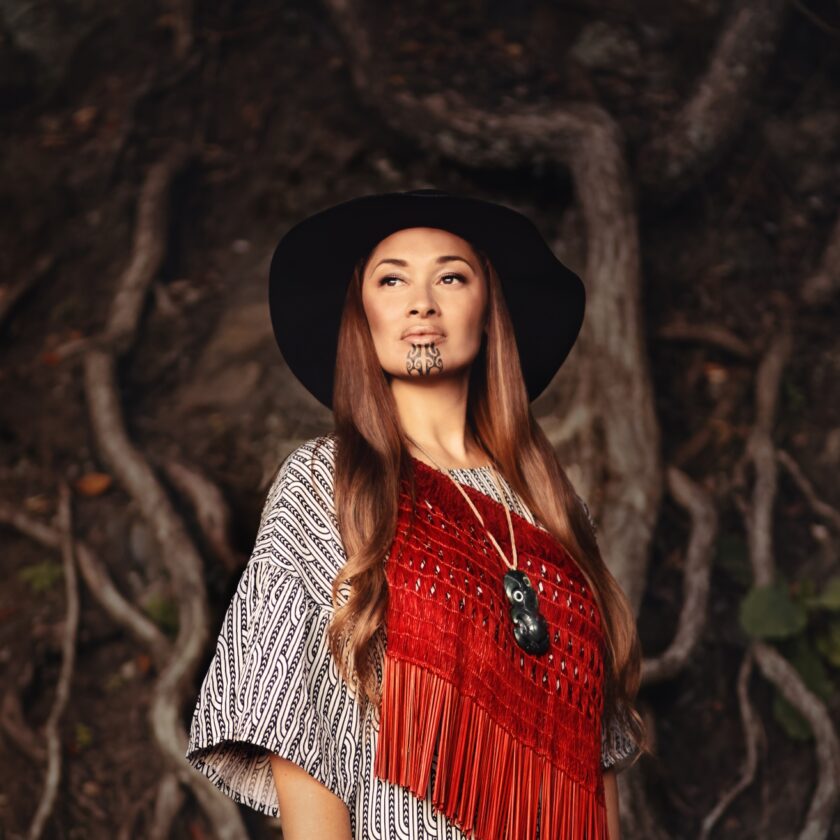
Maisey Rika was named an Arts Foundation Laureate for her contributions to New Zealand music. Courtesy photo
Widely regarded as a national treasure, New Zealand’s Maisey Rika blends te reo Māori and English lyrics with captivating songs exploring themes such as whānau (family), aroha (love), identity, spirituality and connection to the land.
“My culture will always come through in my songs because that’s how I was brought up,” Rika explained. “It’s soulful and raw. I like to bring elements like the ocean into my songs. I believe we’re all connected in some ways, and I just want people to connect and me connect with them.”
With a vocal style that has been compared to India.Arie, she was named an Arts Foundation Laureate in 2021 for her contributions to New Zealand music.
“Maisey’s songs are expressions of a worldview that is anchored in and of te ao Māori, and full of the principles and values that define her perspective as an artist: whānau, kaitiakitanga, aroha, rangatiratanga, tukuihotanga to name but a few,” the Arts Foundation selection panel noted. “She’s an outstanding artist and a generous advocate.”
As a child, Rika attended a kōhanga reo, a kura kaupapa and Māori boarding schools, where she learned the language, and she had a desire to sing from a young age.
She cited a number of leading artists as inspiration, including Sade, Dusty Springfield, Cat Stevens, Tracy Chapman and Lauryn Hill, “conscious writers in the mainstream world, and there are Māori writers too.”
Rika’s early breakthrough came with “E Hine,” a collection of traditional Māori songs recorded with her school choir when she was 13. Two years later, her debut EP, “E Hine,” won Best Māori Language Album at the New Zealand Music Awards, with the album achieving double-platinum status. Rika was also nominated for Best Female Vocalist at 15 years old.
The rising star swept the Māori Music Awards in 2010, winning Best Māori Female Artist (for the second year in a row), Best Māori Pop Album for “Tohu” and Best Māori Songwriter of the Year.
“I was overwhelmed,” Rika recalled. “I was up against people I looked up to and listened to growing up. I was also a bit worried, and asked by aunty what responsibilities for my people come with the awards. She said, ‘Keep doing what you’re doing. The ancestors are there to protect you, so just keep going’.”
On “Tohu,” Rika highlighted the issue of cultural alienation. She sang about young Māori impacted by addiction on “Game of Life” with lyrics like: “Another waste, Descendants of the chiefs, Their blood absorbed into this land, Where we now live as slaves … I see it in our kids, The remnants of the leaders we were.”
“It was written for young people who have gone off the rails a bit,” she explained. “I like to take my strength from our ancestors who have gone before us, when we were strong and noble people, and that’s what I’m trying to say in it. I see too much potential going to waste. I want them to know there is light and hope.”
Another powerful song on the album, “Nia,” is an homage to a 3-year-old girl who was murdered by family members. “I wish I didn’t have to write songs like ‘Nia,'” she said. “But I have to because this sort of thing is still going on, and we need to stand up for them. We are their voice — all they can do is cry.”
In 2013, her album “Whitiora” won more awards, including Best Māori Video for her song “Tangaroa Whakamautai,” a soulful invocation to the Māori god of the sea. A couple of years later, her Christmas collection, “Tira,” featured reworked Christmas songs like “Tapu Te Pō” (Oh Holy Night) and “Pōmārie” (Silent Night).
Rika’s acclaimed album, “Ngā Mata o te Ariki Tāwhirimatea,” was inspired by the Matariki star cluster (the Pleiades). Among the highlights, the beautiful song “Matariki” reflected connection to the environment and the gathering of people, while the hypnotic “Pōhutukawa” connected with those who have passed on to the spirit world. With visual artist Erena Koopu, she released a free interactive Māori resource app featuring ancient stories and traditions pertaining to Matariki.
Her most recent studio album, “Hinamarama,” included memorable songs like the gorgeous “Hinamarama (Karakia)” and the rousing, hip-hop flavored “Tamatea,” which drew from celestial and ancestral inspirations. “The inner peace is the most precious thing,” she sings on “Hinamarama (Karakia).” “Give your life, For the life of the land, For the life of humanity, For the light of my life.”
Rika and her band Hoea will perform at 7:30 p.m. Sunday in the Maui Arts & Cultural Center’s Castle Theater. Tickets are $27 to $67 at MauiArts.org.
Local News

New Zealand national treasure Maisey Rika returns to Maui

Magical world of ‘Frozen’ opens Friday
Man charged with murdering his father held without bail
A man accused of killing his father is scheduled to have a bail hearing in Maui Circuit Court on April 22. James ...
Coastal stewardship event at Baldwin Beach on April 20
Maui resident named 2026 Miss Aloha Hula at 63rd Merrie Monarch Festival